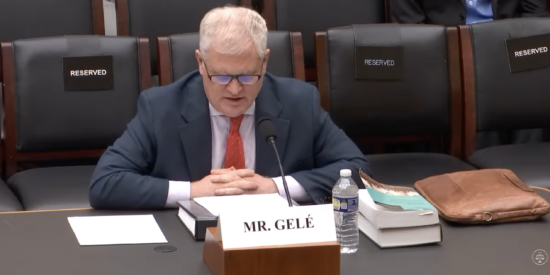
Center General Counsel testifies before the House Judiciary Subcommittee on the Constitution and Limited Government
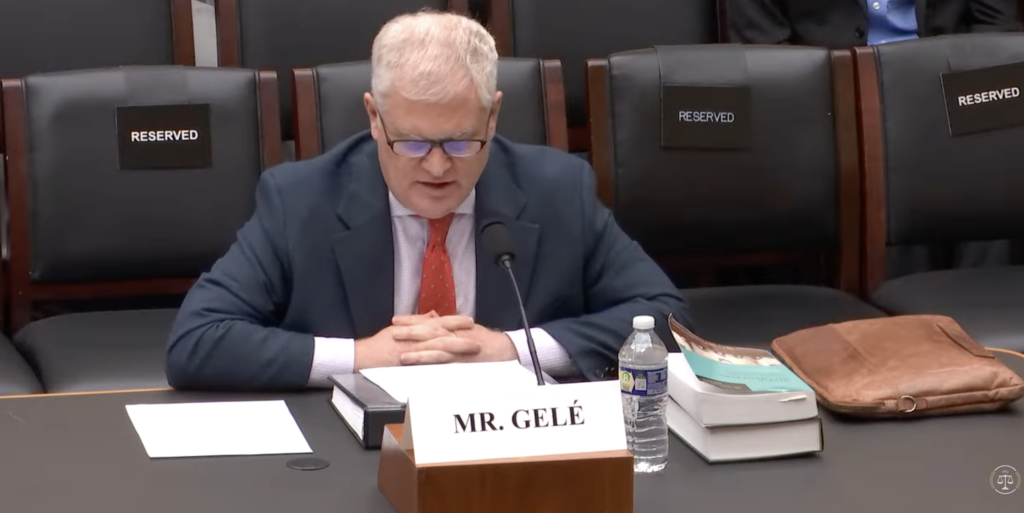

Congressional Testimony of Stephen M. Gelé before The United States House of Representatives Subcommittee on the Constitution and Limited Government of the Committee on the Judiciary “Sharia-Free America: Why Political Islam & Sharia Law Are Incompatible with the U.S. Constitution”
Tuesday, February 10, 2026, 2:00 p.m. Rayburn House Office Building, Room 214
Thank you, Chairman Roy, Ranking Member Scanlon, and Members of the Subcommittee for inviting me here today to discuss: the phenomena of alternative, sharia law-based legal institutions; why the enforcement by American courts of decrees issued by such institutions would be inconsistent with the fundamental rights guaranteed by the United States Constitution; and potential legal remedies to prevent such violation of fundamental constitutional rights.
I am an attorney practicing in the State of Louisiana for over thirty-two (32) years. During the last seventeen (17) years, I have had the opportunity, largely on behalf of the Center for Security Policy, to research and study the interaction of foreign1 law, including Islamic sharia, with American law.
The interaction of foreign law with American law in American courts arises in four (4) contexts: the enforcement of foreign judgments by American courts via comity; the application of foreign law in American courts through conflicts of laws; the enforcement of choice of law clauses in contracts4; the enforcement of forum selection clauses in contracts; the enforcement of arbitration clauses in contracts;6 and the transfer of lawsuits to foreign jurisdictions under the doctrine of forum non conveniens. In all these contexts, American courts–and even American law enforcement–could be called upon to enforce foreign law, even though the enforcement of foreign law would violate fundamental rights guaranteed by the U.S. Constitution.
I have studied the numerous occasions in which discordant foreign law, including sharia, has been litigated before American courts. Although the vast majority of foreign law applications are routine and do not violate American constitutional norms, over the past half century, the number of cases adjudicating the application of discordant foreign law in American State courts, including through arbitrations, has steadily increased. The most prominent category of foreign law that has been increasingly intruding upon American courts is Islamic sharia law, a body of law which consistently violates American public policy and fundamental constitutional rights, including the rights to equal protection (including based on race, religion, and gender), due process, freedom of religion, and freedom of speech. Numerous tenets of sharia show bias against women, the LGBTQ community, non-Muslims, former Muslims, and people designated as blasphemers. Courts in dozens of Muslim-majority nations, and some non-Muslim nations, currently apply sharia.
In hundreds of reported cases throughout the U.S., litigants have attempted to apply sharia, often succeeding. Examples include: the enforcement of foreign child custody judgments or jurisdiction not based on the best interests of the child but instead based on gender or religious discrimination; the transfer of cases to foreign countries whose courts discriminate on gender or religion; the enforcement of Islamic marriage contracts–dubbed mahrs–as prenuptial agreements; talaq or other sharia divorces; and increasingly, the creation of arbitration tribunals applying sharia law within the U.S.15 The law applied by such tribunals discriminates based on gender and religion,1 and in the case of custody disputes, does not apply the best interests of the child standard. Those arbitration tribunals also lack traditional American legal formalities, lessening due process.
Furthermore, legislation over the past half century has suppressed certain American legal protections against the intrusion of discordant foreign law. Public policy exceptions and common law rules have been overwritten by Uniform Acts adopted by the States, sometimes related to foreign treaties. Some Uniform Acts now treat foreign country judgments like sister State judgments, essentially extending the Full Faith & Credit Clause of the U.S. Constitution to foreign nations. Moreover, the U.S. Court of Appeals for the Ninth Circuit has explicitly held that foreign court orders are not subject to the constraints of American constitutional law.
Responding to this encroachment of discordant foreign law into the U.S., multiple efforts have been undertaken, primarily at the State, but also at the federal, level, to address discordant foreign law. The model statute, American Laws for American Courts, passed, in some form, in thirteen (13) States to protect fundamental constitutional rights against the infiltration of foreign law, such as sharia. Similar, but more limited, legislation has been passed by multiple States and the Congress. Legislation requiring some threshold for applying foreign law or empowering foreign venues, includes the SPEECH Act, Rachel’s Law or the Free Speech Defense Act, and several Uniform laws. The SPEECH Act affords to defendants adjudged with libel in a foreign court standing to seek a declaratory judgment from a U.S. district court that any judgments issued by the foreign court are unenforceable. A similar law–dubbed Rachel’s Law or the Free Speech Defense Act–passed in at least eleven (11) States. The Free Speech Defense Act/Rachel’s Law affords protections to citizens exercising free speech against judgments rendered in libel suits filed in foreign countries where defendants do not have the same free speech protections that Americans enjoy under the First Amendment to the U.S. Constitution. Statutory provisions establishing thresholds for the application of foreign law can be found in the Uniform Child Custody Jurisdiction Enforcement Act (UCCJEA), the Uniform Interstate Family Support Act (UIFSA), the Uniform Foreign Money-Judgments Recognition Act, and the Uniform Model Choice Of Forum Act. However, these statutes either apply to narrow areas of law, or do not require an analysis of whether the foreign law or tribunal guarantees fundamental constitutional rights.
Potential additional federal legislation–including legislation that would protect Americans from efforts to establish alternative, sharia-based institutions–could include: strengthening the SPEECH Act; creating a statutory threshold for the enforcement of foreign country judgments by federal courts; creating a statutory standard for forum non conveniens in federal courts; enacting a federal version of American Laws for American Courts; and funding State efforts to require specific training for family law mediators and arbitrators based upon States restricting arbitrations.
Americans have for over two hundred and fifty (250) years, toiled and suffered, including spilling blood, towards guaranteeing fundamental constitutional rights: by war against foreign tyrannies and domestic insurrection; by engaging in social and political movements, such as the suffragette and civil rights movements; and by creating landmark legal precedents. No U.S. citizen should be denied the fundamental liberties guaranteed in our constitutional republic. Women and children, common victims of discriminatory foreign laws, especially deserve protection. The intrusion of discordant foreign laws, including sharia, into the American legal system should be resisted.
Thank you for your time, and I look forward to answering your questions.