New French internal security report on Muslim Brotherhood confirms the Center’s writings over the past 25 years
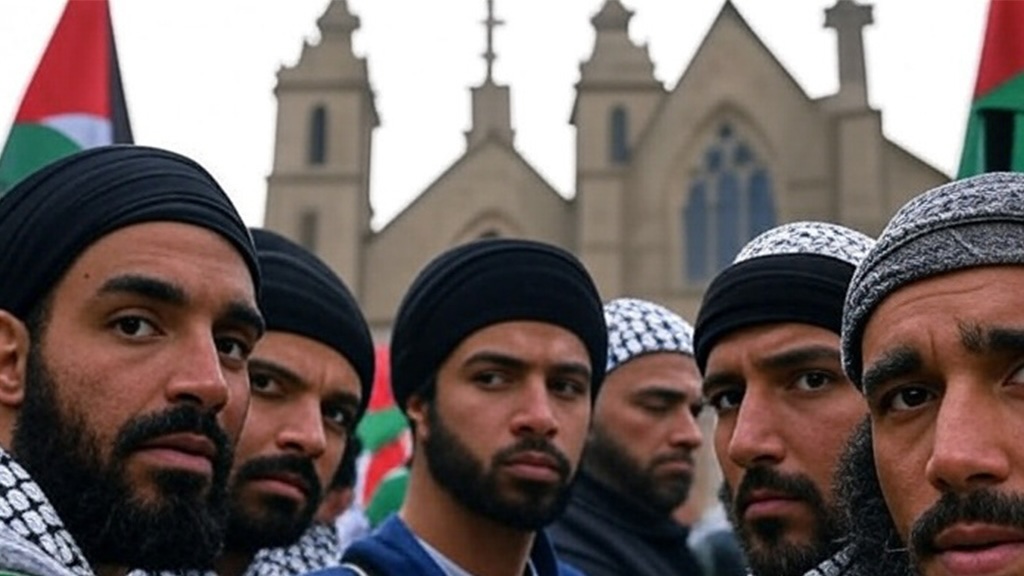

The French internal security service has published an extraordinary report on the Muslim Brotherhood. The report is an important new guide to understanding the networks, its history, its ideology, its modus operandi, and its continued ties terrorism.
The Center has not found an official version of the report in English, and have made this translation using Grok AI, for quick analysis and discussion.
Released on May 21, this report, Frères musulmans et islamisme politique en France (The Muslim Brothers and Political Islamism in France) provides vital new insights into the Brotherhood and how it is perceived by a major western security service. While the focus is on France and Europe, lessons can be applied to the United States.
In general, the report confirms what the Center for Security Policy has documented and warned about for the past 25 years.
The translation, published in full below, preserves the original structure, and formatting, while ensuring clarity and accuracy. Due to the document’s length, the translation is concise where possible without omitting key details. The original document truncates at certain points. Grok says it has translated all provided content faithfully, indicating where truncation occurs. For exactness, please refer to the original in French.
J. Michael Waller, Senior Analyst with the Center for Security Policy
FRENCH REPUBLIC
Liberty, Equality, Fraternity
MUSLIM BROTHERHOOD AND POLITICAL ISLAMISM IN FRANCE
TABLE OF CONTENTS
Introduction
- The Muslim Brotherhood Developed the Matrix of Political Islamism, Adapted for Implementation in the West1.1 Founded a Century Ago in Egypt, the Muslim Brotherhood Developed a Vision of Integralist Islamism, Distinct from Salafism1.1.1 The Egyptian Context1.1.2 The Foundations of the Political Project1.1.3 The Concurrent Emergence of Salafism1.2 The Brotherhood’s Ideology Was Adapted to the West for Dissemination Beyond the Arab-Muslim World1.2.1 Rapid Dissemination in the Arab-Muslim World1.2.2 Theorizing Adaptation to the West1.2.3 The Beginnings of Implementation in Europe and France
1.3 The Muslim Brotherhood Methodically Implements an Integralist Islamism
1.3.1 Determinants of the Contemporary Islamist Project
1.3.2 An Implementation Strategy Combining Dissimulation, Quest for Legitimation, and Denunciation of “Islamophobia”
- Losing Influence in the Arab-Muslim World, the Muslim Brotherhood Focuses Its Efforts on Europe2.1 The Muslim Brotherhood Faces a Continuous Decline in Influence in North Africa and the Middle East2.1.1 A Loss of Influence Since the Arab Spring2.1.2 The Turkish Exception, the Last Brotherhood Stronghold in the Middle East2.2 The Muslim Brotherhood Capitalizes on a Long-Standing Dynamic in Europe2.2.1 A Network of Structured Organizations at the European Level, Notably for Lobbying European Institutions2.2.2 Strong National Implantations in Europe and a New Orientation Toward the Balkans
- In France, the Muslim Brotherhood Movement Is Built on a Solid Structure, but Political Islamism Spreads Primarily at the Local Level3.1 The Muslim Brotherhood Has Structured a Significant Network of Implantation in France3.1.1 Muslims of France, the Brotherhood’s Emanation in France3.1.2 Powerful Networks in the Fields of Education, Charity, and Preaching3.2 The Spread of Islamism Today Results Primarily from Militant Activism Rooted at the Municipal Level, Reinforced by a New Generation of Preachers3.2.1 Major Local Ecosystems3.2.2 Elected Officials on the Front Line in Territories Facing Associative Actors and Other Influencers
- Raising Awareness of the Effects of Islamism in France4.1 Better Understanding the Threat4.1.1 Defining4.1.2 Documenting4.4 Prioritizing Issues Related to the Muslim Faith4.4.1 Developing Contemporary Islamology4.4.2 Understanding the Aspirations of the Muslim Population and Sending Strong Messages
Conclusion
ANNEXES
Annex 1: Bibliography
Annex 2: Glossary
INTRODUCTION
The Muslim Brotherhood relies, in its various countries of implantation, on concentric circles, with a core “restricted circle” of sworn militants. This organization is highly likely in France, as it exists elsewhere in Europe, and would consist of only a few hundred members. The broader “Brotherhood movement” encompasses all those who, in contact with or inspired by this “restricted circle,” adopt its modes of action, with varying objectives: re-Islamization, separatism, or sometimes subversion. The task has been to identify the actors, structures—including satellites—and the scope of action and influence of the Muslim Brotherhood in France.
The academic field is deeply divided on this issue, with two perspectives, both worthy of interest, that confront rather than engage with each other:
- An empathetic perspective, which holds that the Brotherhood movement has detached itself from the Muslim Brotherhood’s orbit, with its members acting individually, adapting tradition to the current context, integrating into the social and political life of democratic countries, and showing flexibility on secondary principles.
- A pessimistic perspective, which argues that the integration and participation of the Muslim Brotherhood in Western society, along with their moderate discourse, are merely tactical retreats: the Islamic state remains their long-term goal, pursued by a structured, vertical, and secretive movement.
If a “Brotherhood risk” indeed exists, it must be assessed accurately, particularly at the national level. However, the danger of a composite, ideologically diverse but highly militant municipal Islamism, with growing effects in the public sphere and local politics, appears very real. It stems from networks promoting communal withdrawal, leading to the creation of increasingly numerous Islamist ecosystems. This report seeks to define the nature of this local political Islamist militancy, which goes far beyond preaching, and its effects. It does not directly address Salafist or Tablighi networks, nor the Salafi-jihadist ideology.
The European dimension of the issue is also significant, intrinsically linked to its Turkish component (Milli Görüş) and very present, though more subtle, in the pan-European structure stemming from the Brotherhood. The need for an assessment of the Brotherhood movement is felt in several countries, with varying approaches (United Kingdom, Sweden, Germany, and Austria).
The preparation of this report took place in a delicate context for several reasons.
Firstly, among French Muslims, there is a widespread sentiment of “Islamophobia,” which for a significant portion has become a belief in “state Islamophobia.” The law of August 24, 2021, strengthening respect for republican principles, despite its balanced approach and resolutely secular framework (i.e., applying to all faiths), is strongly rejected by Muslims. Government decisions targeting various organizations or figures associated with the Brotherhood movement have reinforced this sentiment: dissolution of the CCIF, expulsions of Hassan IQUIOUSSEN and Ahmed JABALLAH, termination of the state’s contract with the Averroès high school (59), legal proceedings against the Humani’terre association, etc.
Secondly, the persistent lack of structure in the organization of the Muslim faith, combined with its strong demographic vitality (cf. INED/INSEE TeO2 survey, 2022), gives Islamist activists and their subversive activities considerable leeway. The visibility of markers of an orthodox Islam, difficult to distinguish from Islamism, in the public space of a growing number of territories—around twenty departments—fuels lively debates.
Thirdly, the ongoing war in Gaza following the terrorist attack of October 7, 2023, though prompting fewer public demonstrations or statements from Muslim leaders compared to the 2014 conflict, is on everyone’s mind. Virulent criticism of Israeli authorities and accusations of “double standards” directed at French policy were expressed in nearly all interviews.
The assessment that follows is based on an evaluation conducted in the first half of 2024, relying on:
- A review of extensive academic literature and a series of interviews with 45 French and international academics of diverse perspectives;
- 10 field visits in France and 4 in Europe, with contributions from the diplomatic network;
- Meetings with national Muslim leaders, including three with those from Muslims of France, as well as local Muslim leaders during field visits;
- In-depth discussions with relevant administrations.
This report preserves the work conducted by specialized services, and its findings are independent of their efforts. They do not reflect or justify actions taken by successive governments against Brotherhood-affiliated organizations. Citations are not referenced, but a bibliography is provided in Annex 1.
After recalling the Brotherhood’s history, ideology, and implantation in Europe, as well as attempting to define Islamism (I), the report presents the declining state of the Brotherhood in North Africa and the Middle East and, in contrast, the dynamism of the movement in Europe, where it has structured organizations and significant interfaces with EU institutions (II). It then evaluates the threat posed by Muslims of France and its satellites, particularly in the main fields they have invested in (preaching, education, and charity); the development of Islamist ecosystems in France and the growing importance of influencers (“preachers 2.0”) constitute a threat to national cohesion (III). Finally, it proposes recommendations to raise awareness of the rise of political Islamism while providing a strong, positive response to the expectations of French Muslims regarding issues related to Islam in France (IV).
- THE MUSLIM BROTHERHOOD DEVELOPED THE MATRIX OF POLITICAL ISLAMISM, ADAPTED FOR IMPLEMENTATION IN THE WEST
“We, the Muslim Brotherhood, are like a vast hall where any Muslim can enter through any door to share what they wish. If they seek Sufism, they will find it. If they seek understanding of Islamic jurisprudence, they will find it. If they seek sports or scouting, it is here. If they seek combat and armed struggle, they will find it. You have come to us with concern for the ‘nation.’ Thus, I welcome you.”
– Hassan AL-BANNA (1906-1949), teacher, founder of the Muslim Brotherhood in March 1928 in Ismailia, near Cairo (Egypt).
From its inception, Islam is conceived by the Muslim Brotherhood as an integralist system (shumuliyyat al-islam), governing all aspects of a Muslim’s life beyond the religious sphere alone. This conception guides the actions of the Muslim Brotherhood organization, from its creation in 1928 to the implantation of its satellites in the West, where it has been present in France since the 1960s and has developed methodically, leveraging a characteristic adaptation strategy.
1.1 Founded a Century Ago in Egypt, the Muslim Brotherhood Developed a Vision of Integralist Islamism, Distinct from Salafism
1.1.1 The Egyptian Context
The Muslim Brotherhood was established in 1928 in Egypt, a country then dominated by the British since the 1870s and deeply affected by the collapse of the Ottoman Empire (Treaty of Sèvres, 1920) and the abolition of the sultanate-caliphate in 1924. In this context, the early Muslim Brotherhood advocated a collective societal reaction through grassroots Islamization based on preaching (daawa) to achieve an Islamic government system through the peaceful Islamization of the majority. For the founder, Hassan AL-BANNA, a 22-year-old teacher, “Islam is the solution [to the] military, political, ethnic, and social invasion from the West.”
The global vocation of Islam they promoted, based on the triptych of Religion, Life, and State, was established from the outset. This led to the Brotherhood’s openness to any Muslim seeking an identity-based Islam. It was also coupled with a pyramidal organizational structure, inspired by Hassan AL-BANNA, who retained two key elements from his original Sufi brotherhood: the archetypal confraternal structure and a central focus on education. Thus, from its establishment in Cairo in 1932, the Brotherhood multiplied its sections across Egypt to oversee preaching, education, and charity. A pyramidal command structure (tanzim) was established, led by the Supreme Guide (murshid al-‘amm), elected by the Representative Assembly.
The Muslim Brotherhood’s Pyramidal Organization
A glossary of terms marked with an asterisk is provided in Annex 2.
1.1.2 The Foundations of the Political Project
The Muslim Brotherhood’s project, as defined by Hassan AL-BANNA, revolves around two objectives: the creation of an Islamic state (dawla islamiyya) and the consequent application of sharia. It thus had a political dimension from the outset, explaining the movement’s later reaction against regimes and the adaptation strategy developed in the West: “The Brotherhood is ready to subscribe to a universal political norm […] as long as this ‘state’ can be made ‘Islamic’ by substituting Muslim legal norms, sharia, for European-inspired positive law.”
After Hassan AL-BANNA’s assassination in 1949, Sayyid QUTB (1906-1966) became a key reference for the movement, despite the denunciation of his radicalism by the general guide Hassan al-Hudaybi. Qutb’s ideas gained traction within and beyond the Brotherhood. Advocating a more radical vision, he criticized the slow pace of grassroots Islamization and promoted the effectiveness of takfir (excommunication) and jihad, arguing that the “true” Muslim is “obliged to overthrow and kill” to establish an Islamic state. While violence was not officially integrated into the Brotherhood’s framework, Hassan AL-BANNA himself had advocated its use to protect preaching, not only against the British or “Zionists.” Today, Sayyid QUTB, a prolific author whose writings range from conservative to revolutionary, is still cited by Brotherhood cadres, particularly at youth camps in Europe.
The Western conquest strategy, outlined by Hassan AL-BANNA, relies on preaching: “We will not stop there but will pursue this evil force to its own lands, invade its Western heart, and fight to defeat it until the whole world cries out in the name of the Prophet and the teachings of Islam spread worldwide.”
1.1.3 The Concurrent Emergence of Salafism
The Muslim Brotherhood emerged within the Arab reformist trend active since the late 19th century, the Nahda (awakening), from which Salafism also stems. This trend paradoxically blended modernism and fundamentalism, reflecting an era of Ottoman traditionalism and openness to European models. Two ideological components shaped it: the promotion of Arab identity and Islamicity, termed Salafiyya, from which both Salafism (with Wahhabism as its 18th-century precursor, formalized in Cairo in 1926) and the Muslim Brotherhood (founded in 1928) emerged.
These two movements remain distinct, pursuing different objectives:
- Salafists focus on refining Islam’s definition, dominating the Islamic publishing market by 1950 with a rigorist, literalist reading and widespread orthopraxy in the Arab world.
- The Muslim Brotherhood invests in the political sphere to implement a sharia-based societal project, producing identity-based Islamic markers and frameworks, with little interest in theological debates dominated by Salafists.
Despite their differences, the two currents, born concurrently, maintain ongoing proximity, experiencing hybridization and, at times, fusion, such as in Saudi Arabia’s Sahwa movement in the 1970s-1980s or in Egypt during Mohamed MORSI’s 2012 victory.
1.2 The Brotherhood’s Ideology Was Adapted to the West for Dissemination Beyond the Arab-Muslim World
1.2.1 Rapid Dissemination in the Arab-Muslim World
Until the early 1950s, the Muslim Brotherhood experienced a “golden age,” marked by rapid expansion in Egypt’s Arab neighbors: Palestine, where Said RAMADAN established an anti-Zionist group in 1945, as well as Syria, Iraq, Lebanon (via Jamaa Islamiyya), and Jordan. They even established a presence in North Yemen, despite its Shiite leadership.
Significant political, demographic, and religious changes in the Arab-Muslim world from 1950 slowed the Brotherhood’s progress but did not prevent it from establishing itself as the ideological and organizational reference for pan-Islamism by the early 1980s:
- Hostility from the Egyptian regime increased after Hassan AL-BANNA’s death and under Sayyid QUTB’s radical leadership, leading to their flight to neighboring countries—Lebanon, Jordan, and Gulf states. Hanbali and Salafist Saudi Arabia became their primary host, where the Brotherhood played a significant role in structuring Salafist organizations like the Muslim World League (1962), the World Assembly of Muslim Youth (1972), and universities, shaping Saudi elites for over three decades.
- Meanwhile, the Brotherhood gradually structured its presence in the Maghreb. In Algeria, the National Liberation Front’s (FLN) investment in conservative religion from the 1970s favored their development. In Tunisia and Morocco, however, secularism under Habib BOURGUIBA and religious control by King Mohammed V and Hassan II limited Egyptian Islamist influence until the 1970s, when their societal penetration became effective.
1.2.2 Theorizing Adaptation to the West
Two major figures shaped the Brotherhood’s ideological trajectory in Europe after the arrival of Muslim immigrant workers: Youssef AL-QARADAWI, the movement’s spiritual leader from the 1960s, and the RAMADAN dynasty, direct descendants of Hassan AL-BANNA.
1.2.2.1 Youssef AL-QARADAWI, the “Thinker of Ideological Derogations” for the West
Before seeking refuge in Qatar in 1961, AL-QARADAWI supervised Egypt’s imam institute and became the Brotherhood’s spiritual guide until his death in 2022. He adapted the ideological corpus, promoting two key concepts for disseminating Islamism in Europe:
- The “juste milieu” Islam, seeking a supposed balance between conservatism and modernity, countering QUTB’s radical school. AL-QARADAWI validated the dar al-daawa concept, making Europe a land of preaching and Islamic reform.
- The “minority rights” principle, adapting Muslims to minority contexts. His fatwas allowed European Muslims to accept bank loans (initially forbidden) for property purchases, simplified dietary rules with a “bismillah” for meat, and relaxed Ramadan fasting for demanding jobs or exams, prioritizing “citizenship” over the Oumma to ease life in minority settings.
However, his deeply antisemitic and anti-American stances mark a fracture with his reformism:
- In his Al Jazeera show “Sharia and Life” (January 2009), he stated: “Throughout history, Allah imposed on the Jews people to punish them for their corruption […] the last punishment was carried out by Hitler. Through all he did to them—though they exaggerated this issue—he managed to put them in their place. […] I hope, as my life nears its end, Allah grants me the chance to go to the land of Jihad and resistance, even in a wheelchair. I will shoot at Allah’s enemies, the Jews, and they will throw a bomb at me, sealing my life with martyrdom. Praise be to Allah.”
- During the 2003 U.S. invasion of Iraq, he justified suicide attacks (January 7, 2005): “It is permissible to endanger one’s life and confront the enemy if it harms them […] If Iraqis can face the enemy, martyrdom acts are unnecessary. If they cannot, such acts are permitted. I haven’t said Iraqis cannot—it depends on their needs.”
1.2.2.2 Tariq RAMADAN, Promoter of an Identity-Based, Modernized Vision of Muslims in Minority Contexts
Grandson of Hassan AL-BANNA through his mother, raised in Switzerland where his father Said founded the Islamic Center of Geneva in 1961, Tariq RAMADAN emerged as a leading voice for young Muslims in Europe from the 1980s to 2000s. He built his platform through the Union of Young Muslims (UJM, founded in Lyon in 1987), the Tawhid center (bookstore and publisher), and the Muslim Presence foundation. His book Muslims in Secularism (1994) resonated widely, especially among French and Belgian youth, advocating a “European Islam.”
Claiming autonomy from the Brotherhood (“I am not a Muslim Brother and never have been. I’ve always been rebellious to structures”), he abandoned the minority rights notion and AL-QARADAWI’s doctrine, promoting “Muslim citizenship.” He positioned himself as repairing Islamic civilization’s identity: “The vast majority of Muslims, politically, economically, socially, and educationally, are in a state of fragility, exclusion, and intellectual marginalization, not participating enough in a true civilizational debate with dominant cultures.”
However, his positions on key issues reveal a double discourse characteristic of the Brotherhood:
- On other religions: While praising figures from other faiths, he denigrates the religions themselves (“Jewish or Christian references have diluted or disappeared”) and sees Islam as filling a spiritual void in the West.
- On economics: He calls for resistance based on “Islamic reference, Muslim values, and Islamic ethical principles—the neoliberal capitalist system […] is a world of war (‘alam al-harb).” He views economic conflicts as misidentified religious ones.
- On radicalization and terrorism: He attributes terrorism to repressive, corrupt regimes, denying Islamism’s role, and warns that mismanaged reformist thought can produce dangerous reactionary attitudes among Western Muslims.
1.2.3 The Beginnings of Implantation in Europe and France
The Brotherhood’s European penetration occurred amid migratory movements and repression in the Muslim world from the 1950s. Early implantation served as a foundation for a new generation of Islamist militants integrating into European universities.
Middle Eastern Brotherhood members settled in Britain, Germany, and Switzerland from the 1950s, followed by Belgium, France, and Italy, concentrating in strategic cities like Aachen or London, forming a “pious bourgeoisie.” In France, a religious consciousness emerged among Muslim immigrant workers in the 1950s, notably around Mohammed HAMIDULLAH, an Indian scholar and political refugee preaching at the Daawa mosque in Paris. Under his influence, the Association of Islamic Students of France (AEIF) was founded in 1963.
Meanwhile, Said RAMADAN, Hassan AL-BANNA’s son-in-law and natural successor, exiled from Egypt, settled in Switzerland, founding the Islamic Center of Geneva in 1961 with Saudi support. It quickly forged ties with the nascent AEIF in France. The movement’s structuring in France continued in the 1970s, unified by two students arriving in the early 1980s: Lebanese Faycal MAWLAWI and Tunisian Ahmed JABALLAH, key Brotherhood emissaries and organic intellectuals, structuring the Union of Islamic Organizations in France (UOIF) from 1983.
1.3 The Muslim Brotherhood Methodically Implements an Integralist Islamism
While the terms Islam and Islamism were often used interchangeably in France, the concept of Islamism as an ideology appeared in 1980 in Revue Esprit by anthropologist Jean-François Clément. In academia since the 1990s, Islamism refers to a politico-religious ideology with an integralist character, with the Muslim Brotherhood as its initial matrix, shaping its discourse.
Islamism, per an academic, is “an exacerbated politicization of Islam, its norms, and values, real or presumed,” varying in intensity and dimensions: minimalist or maximalist, legalist or violent, depending on contexts and actors, intersecting the religious, moral, socioeconomic, and political.
The Brotherhood established a complex ideology with three dimensions: (i) an apologetic vision producing a canonical norm, (ii) a social realization dimension (collective and individual), and (iii) a political aim (sharia centrality) adapted to a secularized space.
Unlike other Islamist currents—proselytizing Salafists and Tablighis using daawa, or radical jihadist Mujahideen using violence and takfir—the Brotherhood’s political ideology, Westernized for Europe, blends Middle Eastern tradition inculturation with tactical dissimulation of subversive integralism, identifiable by its invariant precepts.
1.3.1 Determinants of the Contemporary Islamist Project
1.3.1.1 The Preeminence of Quranic Law in an Integralist Perspective
The Quran remains the Brotherhood’s source of legitimacy, as evidenced by its slogan framing its historic logo: “Allah is our goal, the Prophet our leader, the Quran our Constitution, Jihad our path, Martyrdom our greatest hope.”
In the 1960s, Said RAMADAN clarified the integralist ideology, placing the Quran above all: “We believe Islam is an inclusive system; it is faith and worship, a state, nationality, religion, spirit, action, sacred text, and sword […] The Glorious Quran considers these at the heart of Islam.” Sayyid QUTB, in In the Shade of the Quran, bases his project on the Quran, using passages to denounce Nasserist imperialism.
Integralism, widespread in the Muslim world, is not unique to the Brotherhood but was significantly spread by it. No aspect of individual or collective life escapes Islamic pronouncements by “Islamic sciences” experts. Temporary derogations are possible based on community “interest,” “goals,” or power dynamics. The Brotherhood’s integralism leads to transactional behaviors while maintaining an integral discourse, ultimately resulting in adherence or confrontation.
1.3.1.2 A Variable Conception of Otherness, Particularly Religious
The Brotherhood’s religious tolerance serves political objectives, masking an inability to truly conceive otherness in a secularized society.
While Hassan AL-BANNA advocated overcoming Muslim divergences by embracing Shiism and Sufism (unlike Salafism) to unify the Oumma, this recognized Islam’s primacy, rejecting “People of the Book” (Jews and Christians), whose “attitude is condemned by the Quran” per QUTB. AL-QARADAWI refers to Christians’ “subordinate status” and denies equal rights in Muslim-dominated contexts. Antisemitic conspiracy theories and hatred of Jews are a significant ideological component, relayed by historic Brotherhood cadres.
In France, Islamo-Christian dialogue involving Brotherhood actors is often insincere, used tactically by the UOIF for legitimacy, as seen in the 1990s with the Association of Muslims of Gironde. Abdallah BEN MANSOUR, CEM president, publicly denounces “lies spread in Christianity’s name” and asserts the “superiority of the Quranic narrative.” Accounts from defectors highlight cynicism in the Ligue Islamique du Nord’s relations with parishes. Genuine openness exists but is often driven by former Brotherhood members.
1.3.1.2 A Variable Conception of Otherness, Particularly Religious
The religious tolerance practiced by the Muslim Brotherhood appears to serve political objectives and poorly masks their genuine inability to conceive of otherness in a secularized society.
While Hassan AL-BANNA prescribed overcoming divergences among Muslims by embracing Shiism and Sufism (unlike Salafism), this promotion of plurality within Islam and the desire to transcend legal schools also aimed to secure the Muslim Brotherhood a central position within a unified Muslim community—the Oumma. The primacy granted to Islam is accompanied by the rejection of the religion of the “People of the Book,” namely Jews and Christians, whose “attitude is condemned by the Quran,” according to QUTB. Beyond documented antisemitism (cf. supra), AL-QARADAWI refers to the “subordinate status” of Christians and considers that equality of duties and rights is not guaranteed for Christians and Jews in a context of Muslim domination. Antisemitic conspiracy theories and hatred toward Jews have been, from the outset, a significant component of Brotherhood ideology, relayed in one form or another by all historical cadres of the movement.
In France, Islamo-Christian dialogue, when it involves Brotherhood actors, seems fraught with pretense. It was, indeed, a tactical option for the UOIF in its quest for legitimacy vis-à-vis public authorities. Its testing ground was, in the 1990s, as shown in academic literature, the Association of Muslims of Gironde. An equivocal relationship with religious otherness is the dominant norm among the movement’s cadres. Abdallah BEN MANSOUR, president of the CEM, who likes to highlight his ecclesiastical friendships, denounces in a video “the lies spread in the name of Christianity” and asserts “the superiority of the Quranic narrative and […] the falsity of others.” Accounts from “defectors” evoke the cynicism of the Ligue Islamique du Nord’s cadres in their relations with parishes. Authentic openness exists but appears to be driven primarily by cadres who have left the movement.
Some who saw Islamo-Christian dialogue as a privileged vector for the civic inclusion of the Muslim community in the Republic have largely reconsidered. This interreligious dialogue generally remains incapable of seriously debating sensitive theological issues. Sincere dialogue is particularly hindered by the issue of apostasy in Islam, which forces all of the hundreds of Muslims baptized each year (350 in 2024) to conceal their conversion to Christianity, forming a “silent Church, like in China,” according to a bishop. On this matter, the rule set by AL-QARADAWI remains dominant, stating that “the apostate threatens the integrity and survival of Islam.” For him, the ultimate punishment is justified (“No community accepts that one of its members changes identity or turns loyalty toward its enemies”). Tariq RAMADAN leaves “judgment to God in the hereafter.”
A fortiori, the Brotherhood’s conception of the relationship between a Muslim believer in a minority context and an agnostic, or even an atheist, is even more limited, despite postures of civic openness.
1.3.1.3 The Subordination of Women (but Valorization of the Veiled Woman)
While the Muslim Brotherhood in Europe is more favorable to women’s participation in the workforce than other Islamic traditions, their ideology remains rooted in a “sex-specific, even gendered” determination that establishes non-mixing as a rule and instrumentalizes the wearing of the veil.
Tariq RAMADAN and his brother Hani have placed the “veiled woman” at the heart of the strategy for expanding Muslim culturalism, in opposition to the West. While they promote “an Islamic femininity [based on] the dignity and autonomy of the female being, legal equality, and complementarity by nature,” the model of the liberated Western woman appears to be proscribed in Islam, as does the marriage of a Muslim woman to a man of another religion.
The veil becomes one of the political markers of the Muslim Brotherhood in Europe. While Tariq RAMADAN has publicly defended women’s freedom to choose whether to wear it, he recalls that Islam requires women to veil themselves. In this regard, his brother Hani stated in 2016: “A woman without a veil is like a two-euro coin. Visible to all, she passes from hand to hand.”
At the French level, the 1989 Creil veil affair allowed the UOIF to position itself as the standard-bearer of the Muslim community by defending the young women involved. In the early 2000s, at the Bourget fair, Ahmed JABALLAH’s wife, Noura JABALLAH, then president of the French League of Muslim Women, declared: “Wearing the veil is an act of faith. It is God who ordained it.”
Within the Brotherhood, the roles assigned to women remain confined to motherhood and supporting men, as defined by Hassan AL-BANNA in the 1930s. Their role remained marginal until the collapse of MORSI’s system in Egypt in 2013, which led to the imprisonment of many men and the elevation, by substitution, of the “Muslim Sisters,” whose action focused on three areas: “daawa (preaching), an affirmation of the identity of militant women within the organization, and professionalism in the organization’s administration.”
In Europe, a few central female figures have directly contributed to structuring the movement, such as Nadia KARMOUS, wife of Swiss Mohammed KARMOUS, founder of the IESH in Europe. She created a true Islamic sorority in Switzerland and introduced a “halal” look, as well as ways of speaking and dressing as a Muslim woman. A parallel recruitment system for women existed alongside that for men, including in France until the mid-1990s.
The visibility of these female figures is enhanced by the actions of a third generation of women, whose religiosity is less pronounced, who have pursued higher education, gone through the militant associative cursus, and adopt an even more republican discourse, such as Myriam BERKANE, president of the IESH in Saint-Denis, or Hania CHALAL, a Strasbourg student who served as president of Muslim Students of France and then of the Forum of European Muslim Youth and Student Organizations (FEMYSO). Some of them appear to be positioned to signal modernity, without holding real responsibility.
1.3.1.4 The Israeli-Palestinian Conflict, an Eternal Driver of Anti-Zionism, Increasingly Overt Antisemitism
The Muslim Brotherhood strengthened its post-war presence in Palestine, where Said RAMADAN was dispatched by Hassan AL-BANNA to structure the organization. Hamas, created in 1987, emerged from it and remains connected to the movement, despite recent organizational and strategic emancipation.
The Muslim Brotherhood and Hamas
In the context of the end of World War II, the Palestine issue was a decisive catalyst for the Brotherhood, which capitalized on violent incidents to mobilize its supporters and increase their numbers. It called for an end to Jewish immigration to Palestine and a boycott in Egypt of products from Jewish and Western businesses. Hassan AL-BANNA, who maintained cordial relations with Hajj Amin AL-HUSSEINI, the mufti of Jerusalem, sent Said RAMADAN to establish the Brotherhood in Palestine. The movement attempted to gain traction by aligning with local notables from the mufti’s family. Rising hostilities and the start of the Palestine War exacerbated anti-Western sentiment in Egypt, benefiting the Brotherhood, which even sent volunteers to fight alongside Palestinians. In this context, the Brotherhood assassinated the Egyptian Prime Minister in 1948.
Said RAMADAN organized the “Jerusalem Islamic Congress” in Jerusalem in December 1953 for Palestine, during which a principle of global solidarity against Zionism was established. The congress’s conclusions called on all Muslims worldwide to consider Palestine their cause. Expelled, Said RAMADAN undertook a tour of non-Arab Muslim countries (Pakistan, India, Indonesia, Burma) to encourage a solidarity movement with the cause.
From the 1980s, Palestinian Brotherhood members separated from the international organization and established their own movement during the first intifada in 1987. Named Hamas (Islamic Resistance Movement), and despite coordination with the international structure, the new movement’s charter explicitly mentioned its attachment to the Muslim Brotherhood.
Following the election of its political bureau in 2017, Hamas published a “political framework document” revising its 1988 charter and paving the way for distancing itself from Brotherhood doctrine. The new document aligns Hamas more closely with the Palestinian national movement and initiates an image shift from a “Palestinian religious Islamic movement” to a “national liberation movement” with Islamic references. As a sign of this transition, Hamas no longer defines itself in this document as a movement stemming from the Muslim Brotherhood, nor does it mention its historical organizational and intellectual origins. Notably, there are no longer citations of Hassan AL-BANNA in the new text.
A second distancing from the movement occurred in 2022 when Hamas announced the reopening of a representative office in Damascus, formalizing the normalization of its relations with the Syrian regime, which provoked an outcry among the Brotherhood in Syria and beyond in the region.
At the heart of current events since the terrorist attack of October 7, Hamas can still be considered part of the Brotherhood movement, even if it is organizationally distinct. The movement is led by diverse personalities who, while all originating from the Muslim Brotherhood, now vary in their affiliations and ideologies. However, in the wake of the October 7 attacks, Nawaf TAKROURI, a member of the International Union of Muslim Scholars (IUMS) and former Hamas member, justified a fatwa calling for jihad and personally called for jihad and the killing of Israeli soldiers and settlers. Nawaf TAKROURI also appeared at a tribute to Youssef NADA, the Brotherhood’s financier who died on December 22, 2024, and at an iftar organized by Salah ABDELHAQ in March 2025. Mohamad NAZAL, a member of Hamas’s political bureau, also delivered a speech at the tribute to Youssef NADA.
The Israeli-Palestinian conflict acts as a catalyst for the anti-Zionism historically carried by the Brotherhood and its mutation into antisemitism within the movement, driven by five factors: conspiratorial arguments, reductio ad Israel (equating Israelis with Jews), the notion of an irreducible Muslim identity (referencing Islamic anti-Judaism), a natural enmity between Jews and Muslims, and irrational opinions.
Viscerally anti-Zionist, Hani RAMADAN, son of Said and brother of Tariq, a figure of the European movement banned from French territory, publicly expresses hostility toward Israel that veers into explicit antisemitism. While he has condemned terrorist attacks, he repeatedly legitimizes armed jihad and Hamas actions, even calling for engagement in support of the Palestinian resistance movement. He also shares antisemitic conspiracy theories.
In France, antisemitism persists in the discourse of movement members. Hassan IQUIOUSSEN, deeply engaged on the issue, delivered a sermon in October 2015 on antisemitism and the Palestinian question, drawing a historical parallel between Nazis and Zionists. In an audio released in 2003-2004 titled “Palestine, History of an Injustice,” he offered a revisionist reading of Jewish history. Additionally, several comparisons have been made by movement cadres between the current situation of Muslims in France and that of Jews during World War II. CCIF members wore yellow stars marked “Muslim” during a notable protest in Paris on November 10, 2019.
Since the attacks of October 7, 2023, there has been a rise in anti-Zionist activities in several French mosques, fueled by anger over the human toll of Israel’s reprisals in Gaza. In a well-established mosque in the greater Paris region, anti-Zionist preachers and speakers were invited to discuss the situation in Palestine. A former Palestinian minister proclaimed “I am Hamas,” eliciting applause from the audience. The Humani’Terre association, chaired by Boubaker EL HADJAMOR, former UOIF treasurer and previously the Committee for Benevolence and Aid to Palestinians, is under a preliminary investigation for terrorism financing due to its alleged ties to Hamas and operates in numerous mosques.
1.3.2 A Strategy of Implantation Combining Dissimulation, Quest for Legitimation, and Denunciation of “Islamophobia”
The Brotherhood’s strategy in Europe remains imbued with the culture of secrecy in which the organization was built under Hassan AL-BANNA’s leadership, seeking to protect itself from British authorities during an era marked by the culture of Marxist-Leninist parties.
Whether a circumstantial means of action or an essential component of the Muslim Brotherhood’s identity, recourse to dissimulation remains a constant feature of their implantation method in Europe and corresponds to the temporality of their agenda, which involves a long-term process of political conquest. It is also manifested through the use of double discourse, which allows them to gain respectability, and recourse to victimization through the loaded concept of “Islamophobia.”
1.3.2.1 The Cult of Secrecy
The Secret Organization, a structure advocating violent action established by Egyptian Brotherhood members in the 1940s, durably shaped the Brotherhood’s clandestine, secretive, and dissimulating reputation. However, the organization has alternately shifted from clandestine to public status based on socialization strategies adapted to its environment.
The organizational model of the Brotherhood created in Egypt, with regional offices and districts overseeing society, was replicated in all countries of implantation. The smallest unit is the family (usar), composed of ten members who meet once a week.
The Brotherhood remains organized in a “restricted circle” that resembles an initiatory secret society with subversive aims:
- The opacity strategy pursued leads to the construction of a dual organization: one official, respecting the legal framework, and another secret, centered around a council of elders (majlis ash-shura);
- The Brotherhood’s members are divided into affiliates, committed members, and actives bound to the Guide by a personal oath of allegiance…
[Truncated content in the original document; refer to original PDF] that the objective was to target “Islamist and far-right extremists who seek to separate Muslims from the rest of society and create divisions within Muslim communities.” To this end, the Government indicated it would rely on the power of parliamentary privilege to designate the individuals and groups in question, despite warnings from its services about the legal implications of such an approach. During his announcement in the House of Commons, Mr. GOVE specified that the organizations to be evaluated under the definition were the far-right groups British National Socialist Movement and Patriotic Alternative, as well as the Muslim groups Muslim Association of Britain, Muslim Engagement and Development (Mend), and Cage. Other organizations whose names were disclosed as potentially falling under the definition include Friends of al-Aqsa, 5Pillars, and Palestine Action.
Beyond this, it appears essential to strengthen the general training of public decision-makers on issues of secularism, knowledge of religions, particularly Islam, and the drivers and manifestations of separatism. The responsibility for training on Islam, on the one hand, and radicalization, on the other, is too dispersed within the state apparatus.
Based on this more comprehensive insight into the challenges facing Islam, public decision-makers, particularly prefects, can continue dialogue with local religious representatives while containing the prominence given to Brotherhood movement representatives. This requires knowing who they are, engaging with them, but never granting them a preeminent position.
4.1.2.3 Continuing Efforts Undertaken at the European Level
It would be appropriate to:
- Continue the sensitization efforts already deployed with the European Commission, officials, and European parliamentarians regarding the Brotherhood and its influence on European institutions; some progress was recorded, notably in the context of negotiations on the 2023 budget; the renewal of commission teams and the opening of each new legislature require this effort to be constantly renewed; the formation of a coalition of like-minded member states on the issue of political Islamism and entryism in European institutions could usefully be formalized to conduct these sensitization actions jointly;
- Regarding the issue of association funding by legal or private entities, it would be useful to raise the Brotherhood movement within the Financial Action Task Force (FATF) for sensitization purposes; the FATF will soon conduct a review of terrorism financing methods, in which the Austrian and Belgian experiences—which investigated the movement’s links with Hamas—could be mobilized to raise awareness among FATF member countries about the issues related to the Brotherhood.
4.2 Prioritizing Issues Related to the Muslim Faith
The fight against Islamism cannot be waged without the support of the population as a whole, and French citizens of Muslim faith or culture in particular. The UOIF took two notable turns over the past decade: its withdrawal in 2011 from the institutional framework of the CFCM to refocus on its base and its name change in 2017 to Muslims of France, a typically Brotherhood synecdoche that expresses its ambition to reach or even embody the entire French community, the largest in Europe. The latter lies at the convergence of the movement’s aims and, for public authorities, the challenges of national cohesion.
Twenty years ago, the “exculturation of Catholicism” was considered inevitable, with Christianity being the “religion exiting religion.” The exit of all religions from contemporary society due to the progressive disinterest of the faithful seemed programmed. However, the dynamism of French Islam—despite its divisions and disorganization—on which the Brotherhood movement seeks to capitalize, constitutes a rebuttal to those who viewed religion as an archaism soluble in secularization. An academic has called for an “implicit negotiation” between two parties:
- On the one hand, French Muslims—the term “citizen of Muslim faith” ignoring, according to him, an increasingly strong collective effect—must be able to fully enter the particular political body of France at a time when they experience an extremely strong sense of rejection;
- On the other hand, the rest of the social body must accept that Islam is a French religion, very likely one of the foremost, if not the foremost, in terms of religious practice, and deserves consideration in this regard, including with respect to some of its customs that it does not share.
However, one may question whether this negotiation can take place today. The necessary mutual trust would require a shared certainty that France “is not and will not be a Muslim country.”
First, one must avoid an essentialized, dehumanized, and faceless view of Islam. Anthropological and historical studies show how “lived Islam” can be fraught with contradictions. Islam is what Muslims make of it since a foundational event, referring to a corpus; their universe has never been closed or fixed. The fact that a significant portion of Muslims worldwide live peacefully as a religious minority has progressive consequences for practice and discourse. The Muslim world is complex and evolving, contrary to what an intransigent discourse would have us believe. For example, the notions of an Islamic state and sharia have not been immutable categories in the Arab world, and no one can today provide an indisputable definition of them.
Nevertheless, political Islamism has very likely not abandoned its long-term goal of Islamizing the country, once the deep re-Islamization of the Muslim community is achieved. The “Islam of the Enlightenment” or “new Islamic thinkers,” if they exist, struggle to find a path among French Muslims. The Quran of Historians, a major work summarizing research on the Quranic text and its context of development, directed by an Islamologist from the EPHE and published in 2019, found no echo in the Muslim community and was even criticized by the Great Mosque of Paris. It is notably by playing on the illusion of the advent of an “Enlightenment Islam,” of which they would be a precursor, that the Muslim Brotherhood has prospered.
From the perspective of public opinion, the debate on the ways and means of harmonious coexistence between practicing French Muslims and secular French is scant. In the media tumult, French Islam is portrayed as a monolith—for some, a new proletariat, while for others, every Muslim is a potential Islamist. In the middle, no Muslim leader dares to appear on television.
For a “third secular way” to emerge, believers have a role to play and must be able to engage more in public debate, as urged by the President of the Republic in his speech at the Bernardins. Conversely, non-religious individuals must, according to Habermas, “translate” their arguments into a universal language and openly consider that dialogue on issues such as solidarity or human dignity can be rich with insights. However, spaces for debate where atheists, agnostics, Christians, Jews, and Muslims can mutually question each other are unfortunately very limited today. They must be encouraged, especially since there is, unfortunately, a suspicion of insincerity among Muslim actors, to which the Brotherhood movement has significantly contributed.
The university must play its role in this regard, “ensuring free dialogue on the great questions of existence,” even though discussion spaces have also shrunk here, notably due to the instrumentalization of religious arguments for political purposes and, today, a less diverse research landscape in the humanities and social sciences, where the Brotherhood movement also embeds itself.
A new public discourse will likely be necessary, one that does not confine the Republic to secularism alone and is capable of proposing the seeds of a “civic friendship.” Islamists offer a grand narrative, against which “republican values” alone are insufficient.
4.2.1 Developing Contemporary Islamology
It is essential to strengthen French research on Islam and Islamism beyond the funding provided by the Ministry of the Interior over the past ten years, in a field where it appears:
- Insufficiently invested: most consulted works are in English, and the two theses on the European Brotherhood movement were published by a Belgian and an Italian;
- Extremely polarized, cf. introduction supra.
This situation is all the more detrimental in a context where the Muslim Brotherhood appears to be pursuing a strategy of “Islamization of knowledge” aimed at “redefining” the humanities and social sciences based on the “Islamic vision” developed by the Brotherhood, encouraging the “de-Westernization of knowledge.” This allows political Islam theorists to be presented favorably, legitimizes the concept of “Islamophobia,” and discredits researchers hostile to political Islamism.
One can only hope for the emergence of a third academic way, less ideologized and more grounded in objective knowledge. There exists a generation of less visible Islamology researchers who should be more actively engaged by public authorities.
The French Institute of Islamology (IFI), currently focused on fundamental Islamology, would benefit from expanding its scope to contemporary fields and new disciplines (sociology, political science). By allocating additional lecturer positions, it would be possible to strengthen French universities in these research areas. An alternative would be, failing that, and as in Austria with the “Dokumentationsstelle Politischer Islam” (cf. supra), to entrust this function to a research body positioned at the interface of relevant ministries.
Beyond this, the cultural and symbolic field should be further engaged. In this regard, it is regrettable that, despite its success, the traveling exhibition on the “Arts of Islam” organized by the Louvre Museum has not been followed up. The Ministry of Culture, as it did on that occasion, should take the lead with cultural operators to ensure that an annual exhibition of this type can be organized in turn by a major cultural operator. Furthermore, efforts should be made to further integrate Muslims into the national narrative, to which they adhere, as evidenced by the success of the Muslim military chaplaincy. Little-known figures such as the resistant Addi Bâ or Bel Hadj El Maafi could be honored, perhaps one day pantheonized.
4.2.2 Understanding the Muslim Population’s Aspirations and Sending Strong Messages
A sense of French unease, to say the least, prevails among Muslims in a context where “Islam continues to be primarily evoked in a negative light and remains widely instrumentalized by the extremist minority that seeks to make the victimhood narrative hegemonic.”
In this context, it is essential to better understand the aspirations of the Muslim population, notably to limit its permeability to Islamism. In this regard, recent surveys, foremost among them INS
EE/INED’s Trajectoires et Origines (TeO, 2022) and the Institut Montaigne’s report, A French Islam is Possible (2016), have undertaken to study religious affiliations and practices: they confirm the higher religiosity of Muslims and the strong dynamism of religious practice, driven by migration and significant intergenerational transmission. This phenomenon is accompanied by an increasing “identarization” of the relationship to religious affiliation, as evidenced by the growing observance of religious injunctions such as wearing the Islamic headscarf or following dietary commandments.
Deepening the religious dimension of the TeO study and updating the Institut Montaigne’s survey seem timely, potentially supported by a methodology adapted to objectify the place of Islamist discourse in the collective imagination of French Muslims.
Countering the sense of rejection that permeates Muslim families also requires sending strong signals, attesting to consideration for them and addressing their aspirations, including and especially on immediate issues that may concern:
- Funeral regulations: It is poorly understood that confessional burial groupings are subject to territorial vagaries and the discretion of mayors, which pushes many of our fellow citizens to bury their loved ones abroad, even though, since the health crisis, the majority would prefer they be buried in France; reaffirming the 2008 circular, or even giving it a legislative basis, would constitute a valuable and anticipated achievement for the Muslim population;
- Arabic learning: This teaching should be developed within the Republic’s schools to no longer leave the monopoly to Quranic schools; in this regard, the project to integrate this teaching into the school curriculum, a perennial issue for fifteen years, would benefit from being revisited. Field feedback indicates an ambiguous effect of International Foreign Language Teaching (EILE, formerly ELCO), which should be evaluated. As the majority of Muslims in France are now French, there is no justification for delegating the teaching of Arabic or Turkish to countries of origin, opening the door to risks of interference that must be fully eliminated, in line with the decisions taken since the President’s 2020 speeches in Mulhouse and Mureaux;
- The French stance on the Israeli-Palestinian conflict: The interviews conducted were affected by the tense climate prevailing in France following October 7 between Jewish and Muslim communities; they highlighted deep unease within the latter, which perceives the French position as openly pro-Israel, in line with an alleged “state Islamophobia,” supporting Jewish Israelis against Muslim Palestinians; while this perception, which extends beyond the Brotherhood movement, does not withstand scrutiny, it is nonetheless instrumentalized by Brotherhood actors; to counter this narrative, and independently of the measures mentioned in this report that would reaffirm that Muslim faith and culture are as respectable as others and that the Republic guarantees their free exercise and manifestation, France’s recognition of a Palestinian state alongside Israel within secure and recognized borders could help alleviate these frustrations.
CONCLUSION
The subversive nature of political Islamism, which aims, in the long term, to change the political and social order, is very present from the Brotherhood’s inception and remains marked in the movement that stems from it. While the ideology has been adapted to the West by AL-QARADAWI and then the RAMADAN family (derogations, practice of double discourse, victimization through the denunciation of an alleged “Islamophobia”) to facilitate its spread in Europe, where Islam is a minority, the initial precepts remain:
- The Muslim Brotherhood’s organization continues to rely in Europe, and probably in France, on a restricted circle of a secretive, pyramidally commanded organization, whose action is relayed and amplified by a broader movement;
- Its deployment strategy continues to prioritize investment in the religious field (mosques, training of religious cadres), education (opening of confessional schools), and social sphere (creation of aid or youth supervision associations);
- The ideological determinants, even subject to tactical retreat and/or concealed behind double discourse and a legalist strategy, remain identifiable: the preeminence of Quranic law over the Republic’s law (“the Quran is our constitution”), the subordination of women, the inability to conceive otherness, particularly religious (the intrinsic superiority of Islam and condemnation of apostasy), and anti-Zionism verging on antisemitism.
Behind a strategy combining dissimulation, the quest for legitimation, and victimization, the French Brotherhood movement, whose transactional strategy is now hybridized with fundamentalist currents (Salafism, Tabligh, Deobandi), appears to pursue with perseverance the same aims for four decades:
- The anti-republican nature of many of its members or affiliates is proven, whether it be its preachers (Hassan IQUIOUSSEN, expelled in 2022), associates like the RAMADAN brothers, or the movement’s associations (the CCIF was dissolved in 2020 for inciting hatred; Humani’Terre is under investigation for terrorism financing);
- Dissimulation strategies have been uncovered, notably in the receipt of foreign funding through its endowment funds and real estate companies (notably from Qatar); Muslims of France’s main endowment fund, Al-Wakf, was dissolved for illegal funding of religious activities;
- The links of the French movement with the European and international levels of the Muslim Brotherhood organization are established: Muslims of France’s cadres form the largest national delegation of the Council of European Muslims (CEM—formerly FOIE), the umbrella organization of the Muslim Brotherhood in Europe. The CEM, which includes 28 national associations, is equipped with a multi-year strategy in Europe and provides a curriculum training national cadres, among others. Its action is relayed by a series of structures, either satellite, such as its youth branch (FEMYSO), or ideologically close, such as the CEFR (theological), Islamic Relief (humanitarian), or Europe Trust (financial); the characterized ideological continuum and the overlapping positions of the same cadres in both organizations seem to demonstrate the CEM’s affiliation with the International Muslim Brotherhood Organization (OIFM), despite systematic denials by its members.
Muslims of France today rests on a solid structure, characteristic of the Brotherhood’s implantation strategy in the West:
- While the persistence of an allegiance system is not firmly established for France, a “restricted circle” of sworn militants exists in all branches of the European movement;
- Based in the 1980s on a dual organization—an unofficial Islamic directorate duplicating the official UOIF structure—the latter has normalized and become established; current MdF cadres are still largely directly derived from the first generation of militants; the French branch has historically adopted, since the Creil veil affair, a continuous legitimation strategy in its interactions with public authorities, positioning itself as more legalist and less confrontational than other European movements; it has also given higher priority than in other countries to the creation of educational establishments; the creation, in the context of Western Europe’s largest Muslim community, of a multiplicity of organizations or institutions for the Muslim community dominates the balance sheet of its 40 years of existence; the specifically French ideological and religious substrate appears limited, contrary to its representatives’ claims;
- The success of its institutionalization and respectability strategy, which reached its peak in the 2000s with its integration into the CFCM, enabled it to establish or inspire powerful local ecosystems over 20 years, structured around major mosques and educational establishments; these have been the springboard for the influence of preachers spreading Brotherhood ideology and the target of influence strategies with elected officials, occasionally involving entryism; elected officials are now subject in many territories to sometimes virulent electoral pressures from Islamist actors, which go beyond the classic management of an electoral population;
In this context, Muslims of France appears as a protean movement (spanning religious, educational, social, and even political spheres) and resembles more a reticular network of solidarity among local baronies than a command structure driven by a rigid ideology, especially since its aging cadres seem to struggle to ensure generational renewal. No recent document demonstrates Muslims of France’s intent to establish an Islamic state in France or to apply sharia there. However, the collected elements confirm the existence of a threat to national cohesion posed by the rise of municipal Islamism, for which the Brotherhood movement bears historical and current responsibility.
It can be estimated that this grassroots diffusion of municipal Islamism constitutes a short- to medium-term threat, which would validate the emergence of veritable confiscated territories. In this regard, the concept of separatism does not fully capture the subversive nature of the project carried by the Muslim Brotherhood, which aims to work over the long term to progressively obtain modifications to local or national rules applying to the population, primarily the legal framework of secularism and gender equality. This is not an aggressive separatism, typically Salafist, aiming to place its affiliates on the margins of society, but a subtle and providentialist, yet no less subversive, vision for institutions.
The reality of this threat, even if it relies on a long temporality and does not resort to violent action, poses the risk of undermining the associative fabric and republican institutions—local authorities in particular—and, more broadly, national cohesion.
Ultimately, in continuity with what has been undertaken in the fight against separatism since 2020, resolute and sustained field action seems necessary to curb the rise of political Islamism. It is essential to accompany this with public sensitization, which must be reconciled with a renewed secular discourse, strong and positive signals to the Muslim community, and a long-term commitment to issues related to the Muslim faith.
Annex 1: Non-Exhaustive Bibliography
- Samir AMGHAR, Militant Islam in Europe, Paris, Infolio, 2013.
- Houda ASAL, “Islamophobia: The Fabrication of a New Concept. State of Research,” Sociologie, 2014/1 (Vol. 5), Presses Universitaires de France, 2014.
- Dominique AVON, “Tariq Ramadan’s Reformist Islam,” Se comprendre, January 2004.
- “The Muslim Brotherhood and the ‘Democratic Civil State with Islamic Reference,’” Les Cahiers de l’Orient (No. 108), 2012/4.
- “Between Power and Repression: Origins and Evolutions of the Muslim Brotherhood,” Revue Moyen-Orient (No. 52), 2021/10-12.
- “Shaykh Yūsuf al-Qaradāwī (1926-2022),” Observatoire des Religions et de la Laïcité, November 2022.
- Hassan AL-BANNA, The Epistles of Imam Hassan al-Banna, Cairo, Al-Matba’a al-‘âlamiyya fî al-Qâhira, 1952.
- Fabrice BALANCHE, “The Muslim Brotherhood: A Movement Seeking a New Breath,” Géopolitique de l’islam (No. 64), Les Grands Dossiers de Diplomatie, 2021.
- Cédric BAYLOCQ and Michaël PRIVOT, Profession Imam: Interview with Tareq Oubrou, Paris, Albin Michel, 2009.
- “Responses of French Muslim Reformists to Belligerent Uses of Fiqh, Hadith, and Sira (Death Penalty in Islam),” in Emmanuel PISANI, Cédric BAYLOCQ, Muslim Theologies of Religious Pluralism, Cerf Patrimoines, 2024.
- “Aspirations for Openness and a Depreciative Paradigm: French Neo-Brotherhood Members Facing Otherness,” forthcoming, 2025.
- Sarah BEN NEFSSA and Pierre VERMEREN (eds.), The Muslim Brotherhood Facing Power: Egypt, Tunisia (2011-2021), Editions Odile Jacob, 2024.
- Sarah BEN NEFSSA, “Producing the ‘True Muslim’ by the Egyptian Muslim Brotherhood: Loyalty and Dissidences,” Revue internationale des études du développement 2017/1 (No. 229).
- Myriam BENRAAD, “Iraqi Muslim Brotherhood: Wavering Trajectory, Uncertain Future,” Moyen-Orient (No. 52), 2021/10-12.
- Florence BERGEAUD-BLACKLER, The Brotherhood and Its Networks: The Investigation, Editions Odile Jacob, January 25, 2023.
- The Halal Market: Or the Invention of a Tradition, Paris, Seuil, 2017.
- Rémy BRAGUE, “The Quran and Anti-Judaism,” Commentaire, 2018/2.
- François BURGAT, Understanding Political Islam: A Research Trajectory on Islamist Otherness, 1973-2016, Paris, Editions La Découverte, 2016.
- “Dynamic and Omnipresent Diversity of the Islamist Reference,” Critique internationale (No. 78), 2018/1.
- “The Muslim Brotherhood in Europe: Between Fantasies and Reality,” Interview with François Burgat by Sylvie Denoix and François Sino for Revue des mondes musulmans et de la Méditerranée, May 2023.
- Olivier CARRE, Mysticism and Politics: The Quran of Islamists. Sayyid Qutb’s Quranic Reading, Radical Muslim Brother (1906-1966), Paris, Cerf, 2004 (1984).
- Amélie M. CHELY, Dictionary of Islamisms, Paris, Editions du Cerf, November 18, 2021.
- Rafik CHEKKAT, “Islamophobia Seeks to Break with Pessimism and Gloom,” Mizane.info, February 3, 2022.
- Laure DAUSSY, “CCIF: How to Take Muslims Hostage,” Charlie Hebdo (No. 1475), October 28, 2020.
- Margot DAZEY, The Politics of the Union of Islamic Organizations of France, Department of Politics and International Studies, University of Cambridge, 2018 (thesis).
- Xavier DELGRANGE, “French Laïcité Pronounced with a Belgian Accent,” Administration & Éducation, vol. 151 (No. 3), 2016.
- Julien DUFURER, “A Roubaix Imam Calls for a ‘Restrained’ Ramadan,” La Voix du Nord, May 21, 2018.
- Reem EL MAHDY, The Compatibility of Yusuf Al Qaradawi’s Wasatiyya School of Thought with the Second Generation of the Muslim Brotherhood [Master’s thesis, the American University in Cairo], AUC, 2015.
- Amin ELIAS, “Sheikh Youssef al-Qaradāwī and the ‘Juste Milieu’ Islam: Critical Perspectives,” Confluences Méditerranée, Winter 2017-2018.
- Jean-Pierre FILIU, The Arab Revolution: Ten Lessons on the Democratic Uprising, Fayard, 2011.
- “Western Muslim Brotherhood,” Le Monde Diplomatique, 2010, https://www.monde-diplomatique.fr/2010/05/FILIU/19118.
- The New Middle East, Fayard, 2013.
- Jean-Pierre FILIU, Bernard RAVENEL, “Revolutions, Counter-Revolutions: What Does the Historian Say?,” Confluences Méditerranée (No. 115), Winter 2020, pp. 25-35.
- Franck FREGOSI, Governing Islam in France, Seuil, January 2025.
- Cécilia GABIZON, “The Star Preacher of the Suburbs Professes Virulent Antisemitism,” Le Figaro, October 28, 2004.
- Marcel GAUCHET, The Religious and the Political: Twelve Responses by Marcel Gauchet, Paris, Desclée de Brouwer, coll. “Religion & Politics,” 2010.
- “The Drivers of Islamic Fundamentalism,” Le Débat, 2015.
- Rethinking Laïcité in Light of Islam, Proceedings of the colloquium “Integration, Laïcité, Continuing France,” 2016.
- Olivier HANNE, L’Alcoran: How Europe Discovered the Quran, Belin, 2019.
- “When Islamology Research Serves Islamophobia,” L’Harmattan, Confluences Méditerranée, 2022.
- Vincent GEISSER, The New Islamophobia, Paris, La Découverte (Sur le vif collection), 2003.
- “Report on ‘Muslim’ Parties, Pressure Groups, and Candidates,” Illuminating the Religious Variable in Electoral Processes, Aix-Marseille University, 2022.
- Alain GRESH, “The Muslim Brotherhood, an Organization Tested by Power,” Moyen-Orient 2021/10-12 (No. 52).
- Stéphane LACROIX, The Twilight of the Saints: History and Politics of Salafism in Egypt, Paris, CNRS Éditions, January 2024.
- Egypt in Revolutions (co-edited with Bernard Rougier), Paris, Presses Universitaires de France, 2015.
- “Gulf Countries Facing the Brotherhood Issue,” Observatoire international du fait religieux (bulletin no. 10), edited by Alain Dieckhoff and Philippe Portier, Paris, Centre de recherches internationales (CRI), 2017.
- Stéphane LE BARS, “We Are Concerned About the Stigmatization of Islam,” Le Monde, April 6, 2012.
- Adrien LOUIS, “Creolization, Republicanism, and National Identity: Examining Three Discourses on Islamism,” La Revue des deux cités: Society, Law, Politics, and Religion, Presses Universitaires de Louvain, 12/2023, pp. 139-156.
- Pierre MANENT, France’s Situation, Editions Desclée de Brouwer, 2015.
- Antoine MENUSIER, “Hassan IQUIOUSSEN Expelled? How the Nord Student Became the ‘Preacher of the Suburbs,’” L’Express, August 2, 2022.
- Hana JABER, “The Jordanian Muslim Brotherhood: From Monarchy’s Pillar to Regime’s Enemy,” Fondation pour la Recherche Stratégique, July 2017.
- Günther JIKELI, “Antisemitism in Muslim Milieus and Countries: Debates and Studies on a Complex Process,” Revue d’Histoire Moderne et Contemporaine, April-September 2015.
- Gilles KEPEL, The Prophet and Pharaoh, Folio Histoire edition, 2012 (thesis).
- Ninety-Three, Gallimard, 2012.
- French Passion: The Voice of the Suburbs, Gallimard, 2014.
- Arab Passion, Folio Actuel edition, 2016.
- Anne-Clémentine LARROQUE, “The Muslim Brotherhood in North Africa: The Outline of a Regional Approach?,” Revue Moyen-Orient (No. 52), 2021/10-12.
- “Jordanian Brotherhood: Political and Social Actor Always on the Edge,” Revue Moyen-Orient (No. 47), 2020, pp. 76-77.
- Islamism in Power: Tunisia, Egypt, Morocco (2011-2017), Paris, Presses Universitaires de France, 2018.
- Geopolitics of Islamisms, Que sais-je?, Presses Universitaires de France, 4th edition, 2024 (2016).
- Nathalie LOISEAU, The War We Don’t See Coming, Paris, Éditions de l’Observatoire, 2022.
- Mohamed LOUIZI, Why I Left the Muslim Brotherhood?, Editions Michalon, January 7, 2016.
- The Republic at Home, Islam at Home, Editions Fauves, December 9, 2019.
- Brigitte MARECHAL, The Muslim Brotherhood in Europe: Roots and Discourses, Paris, Presses Universitaires de France, coll. “Proche Orient,” 2009.
- Nasar MEER and Tarik MODOOD, “Refutations of Racism in the Muslim Question,” Patterns of Prejudice, vol. 43, no. 3-4, 2009.
- Sabrina MERVIN, Nabil MOULINE (eds.), Political Islams: Currents, Doctrines, and Ideologies, Paris, CNRS éditions, 2017.
- Hugo MICHERON, Anger and Oblivion: Democracies Facing European Jihadism, Gallimard, 2023.
- Tareq OUBROU, Call to Reconciliation! Muslim Faith and French Republic Values, Paris, Plon.
- Pascale PASCARILLO, Yann PHILIPPIN, Antton ROUGET, Matthieu SUC, and Marine TURCHI, “Conflans Attack: Revelations on Imam Sefrioui,” Mediapart, October 22, 2020.
- Emmanuel PISANI, “Islam and Islamism: The Challenge of the Theological Question,” Revue Études HS9 (Hors-série), 2009, pp. 19-30.
- Jean-Christophe PLOQUIN, “Olivier Roy: ‘There Is No More Political Islam but Islam in Politics,’” La Croix, January 2, 2014.
- Sagi POLKA, Shaykh Yusuf Al-Qaradawi, Spiritual Mentor of Wasati Salafism, Syracuse University Press, 2019.
- Michael PRIVOT, When I Was a Muslim Brother – Journey Toward an Islam of Enlightenment, Clamecy, Editions La boîte à Pandore, March 23, 2017.
- Works by Youssef AL-QARADAWI, including:
- Islam vs. Laïcité, Cairo, Librairie Wehbi, 1980.
- The Muslim Brotherhood: 70 Years of Preaching, Teaching, and Jihad, Cairo, Maktabat Wehbi, 1998.
- “The Danger of Apostasy… and the Fight Against Discord,” Islamophile, Islamic Resources in French, December 30, 2002.
- The Sense of Priorities, Editions Bayane, 2009.
- The Licit and the Illicit in Islam, Editions Al-Qalam, 2015.
- Bernard ROUGIER (and Stéphane Lacroix, eds.), Egypt in Revolutions, Paris, Presses Universitaires de France, 2015.
- The Conquered Territories of Islamism, Paris, Presses Universitaires de France, 2020.
- Works by Tariq RAMADAN, including:
- Muslims in Secularism, Tawhid, 1994.
- To Be a European Muslim, Islamic Foundation, 1998.
- Being a European Muslim: Study of Islamic Sources in the European Context, Editions Tawhid, September 1999.
- With Jacques Neirynck, Can We Live with Islam? The Clash of Muslim Religion with Secular and Christian Societies, Éditions Favre, April 2000.
- Western Muslims and the Future of Islam, Éditions Sindbad-Actes Sud, January 2003.
- Globalization: Muslim Resistances, Editions Tawhid, November 2003.
- Islam, Radical Reform: Ethics and Liberation, Presses du Châtelet, 2008.
- My Intimate Conviction, Presses du Châtelet, 2009.
- Islam and the Arab Awakening, Presses du Châtelet, November 2011.
- Interview with Tariq RAMADAN in Raphaëlle BACQUE, Besma LAHOURI, “Tariq RAMADAN, the Sphinx,” Le Monde, April 19, 2016.
- Hani RAMADAN, speeches and conferences:
- “Netanyahu, War Crimes, and the Shoah,” blog post, August 29, 2009.
- “Bernard Kouchner and Zionist Logic,” blog post, September 17, 2009.
- Conference at Saint-Étienne for the Committee of Benevolence and Aid to Palestinians (CBSP), October 22, 2011.
- Speech at the 26th UOIF Congress, April 12, 2009.
- Conference at La Chapelle Saint-Luc (10) for the Union of the Muslim Community of Aude, May 10, 2009.
- “The Civilization of the Dajjâl, the Antichrist,” blog post, August 24, 2009.
- Conference at Le Mée sur Seine (77), February 27, 2013.
- “Bin Laden, Merah, the Tsarnaev Brothers, and Others,” blog post, May 3, 2013.
- Gabriel ROBIN, “Elias D’IMZALENE: ‘I Call for a Theology of Resistance to the Country’s Power,’” L’Incorrect, December 5, 2019.
- Olivier ROY, “Neofundamentalism: From the Muslim Brotherhood to the FIS,” Revue Esprit, March-April 1992.
- Genealogy of Islamism, Paris, Fayard, 2011.
- Is Europe Christian?, Paris, Seuil, 2019.
- Wael SALEH and Patrice BRODEUR, Deconstructing Received Ideas on Egyptian Brotherhood Islamism, Trends Research and Advisory, 2024.
- Haoues SENIGUER, “The Ideological Blind Spot of the Collective Against Islamophobia in France,” La Croix, August 25, 2016.
- “The ‘Neo-Muslim Brotherhood’ or Legalist Conservatism: The Case of Muslims of France,” Revue Moyen-Orient, No. 52, 2021.
- “Is Islamism (Still) Hegemonic? Reflections from France on an Incandescent Object,” Revue Confluences Méditerranée, vol. 127, 2023.
- “Islamism and Political Islam: Overview, Issues, and Evolutions,” Revue Les Grands Dossiers de Diplomatie, no. 79, April-May 2024.
- Sylvie TAUSSIG and Bernard GODARD, Muslims in France, Paris, Robert Laffont, 2007.
- Sylvie TAUSSIG and Karim IFRAK, “Islamism Between Methodological Definition and Ideological Approaches,” Revue Société, Droit et Religion, CNRS Editions, pp. 141-161, 2010.
- Xavier TERNISIEN, The Muslim Brotherhood, Paris, Fayard, 2005.
- Tommaso VIRGILI and Giovanni Giacolone, Muslim Brotherhood and Khomeinism in Italy: The Told and the Untold, European Eye on Radicalization, May 2022.
- Sara TONSY, “The Muslim Sisters: Between Revolution and Status Quo Affirmation,” Revue Moyen-Orient 10-12 (No. 52), 2021.
- Marie VANNETZEL, The Egyptian Muslim Brotherhood: Investigation into a Public Secret, Paris, Karthala, 2016.
- “Public Secret, Social Networks, and Political Morality: The Muslim Brotherhood and Egyptian Society,” Politix, no. 92(4), 2010, pp. 77-97. https://doi.org/10.3917/px.092.0077.
- Lorenzo VIDINO, The New Muslim Brotherhood in the West, Columbia University Press, New York, 2010 (thesis).
- Lorenzo VIDINO and Sergio ALTUNA, The Muslim Brotherhood’s Pan-European Structure, Austria Fund for the Documentation of Religiously Motivated Extremism (Documentation Centre Political Islam), 2021.
- The Closed Circle: Joining and Leaving the Muslim Brotherhood in the West, Global Watch Analysis, 2022.
Administrative Reports:
- Senate Information Report on the Application of the August 24, 2021 Law Strengthening Republican Principles, dated March 6, 2024.
- IGA/ISR Report on Retaining Human Resources in Intelligence Services, dated July 16, 2021.
- IGESR Report no. 022-56, Distance Learning Organizations, April 2022.
- Report of the Parliamentary Assembly of the Council of Europe’s Committee on Equality and Non-Discrimination, September 2022.
- Ministerial Internal Audit Mission Report by the General Inspectorate of Education, Sport, and Research (IGESR), Rejection of Republican Values (2019).
- Institut Montaigne, “Journey to the Land of the Muslim Brotherhood,” in The Making of Islamism, 2018.
Academic Studies and Think Tank Reports:
- Universität Wien, Die Islamische Gemeinschaft Milli Görüş, Dokumentationsstelle Politischer Islam, 2023.
- Swiss Center for Islam and Society (Hnajörg SCHMID, Noémie TRUCCO, and Federico BIASCA), Swiss Muslim Communities in Transnational and Local Interactions, SZIG/CSIS Studies 7, University of Fribourg, 2022.
- Dokumentationsstelle Politischer Islam, “Political Islam at the Municipal Level: The Islamic Association in Austria (IVÖ),” Vienna, December 2022.
- Dokumentationsstelle Politischer Islam, “Political Islam as a Subject of Scientific Analysis and the Example of the Muslim Brotherhood,” Vienna, December 2020.
- ENAR Alternative Report, Marwan MUHAMMAD, “Racism and Associated Discriminatory Practices: France,” Shadow Report 2011-2012.
Conferences and Colloquia:
- Monthly seminar “Anthropological Approaches to Radicalization” organized by EHESS. Video conference by Anne-Sophie LAMINE on Beyond Separatism and Radicalization: Thinking Muslim Religious Intensity in France, co-authors Claire DONNET, Iman E. FEKI, Mélodie FOUBERT, Hanane KARIMI, Coline LUTZ, and Bruno MICHON (Diacritiques edition, 2024), EHESS, April 17, 2024.
- Colloquium: “Islamisms in Europe” organized by CNRS, Konrad Adenauer Foundation, Île-de-France Region, CERIF, and the Association for the Defense of Republic Servants, held at the Île-de-France Regional Council, May 15, 2024.
- Conference: “Overview of a Renewed Theological Offer” by sociologist Younes VAN PRAET, organized by historian Jamel EL-HAMRI, Mantes-la-Jolie, May 19, 2024.
- Seminar: “Muslim Political Parties” organized by GSRL (Societies, Religions, Laïcité Group) of EPHE and CNRS, June 4, 2024.
Annex 2: Glossary
Apostasy/Apostate: In Islam, a Muslim who commits a fault by lacking loyalty to the Quranic revelation or by impurely applying the precepts of the Quran and Sunna. This fault is punishable by sanctions up to death. Shiites, Sufis, Kharijites, and Mu’tazilites are deemed apostates by jihadists, often called murtaddin in jihadist lexicon.
Sharia: “Great Islamic law,” both religious and social, followed by Muslims in Islamic states. It derives its essence from the Quran and Sunna and encompasses certain legal principles. Sharia’s application varies across adopting states.
Caliphate: Theocratic political regime in which the caliph holds political and religious power. The term caliph was institutionalized under the Umayyad caliphate and ended in 1924 with the abolition of the Ottoman caliphate.
Shiism: Minority Islamic branch attached to Ali, the Prophet’s son-in-law and cousin, and his descendants. Shiites have an organized clergy, unlike Sunnis, but do not recognize the Sunna.
Daawa: Preaching.
Dar al-daawa: Territory of preaching, situated between Dar al-Harb (land of war) and Dar al-Islam (land of Islam).
Dhimmis: Non-Muslims who pay a tax.
Fatwa: “Legal opinion” issued by a jurist or, for Twelver Shiites, an ayatollah.
Halal: What is licit.
Hanbalism: Sunni juridical school from the 9th century, contesting caliphal power and allowing only a strictly codified textual interpretation—literalism—without interpretive leeway.
Haram: What is illicit.
Hijra/Hegira: Emigration of a Muslim from a non-Muslim territory to a Muslim state, referencing Muhammad’s emigration to Medina in 622.
Integralism: Conception according to which:
- The political cannot override the religious in conflicts;
- Profane science cannot override the religious in conflicts;
- A religious community (here, Islam) must have specific rights.
Intifada: “Uprising.” Palestinian uprisings against Israeli occupation.
Islamic: Adjective denoting intent grounded in Islam.
Islamism: Exacerbated politicization of Islam, its norms, and values, real or presumed, varying in intensity and dimensions: it can be exercised in a minimalist or maximalist, legalist or violent mode. The path taken depends greatly on contexts and actors. Islamism is thus at the crossroads of the religious, moral, socioeconomic, and political.
Jihad: “Effort on God’s path.” A means to reach God through effort, mentioned in the Quran and Sunna. There are two types: greater jihad (personal, spiritual effort) and lesser jihad (legitimate defense against attack). Offensive jihad appears in some hadiths.
Oumma: The global Muslim community, a contraction of Oumma Islamiyya (Islamic community).
Quietism: Religious doctrine holding that only divine intervention ensures the proper functioning of the believing community, without political involvement.
Sahwa: Reformist Salafist current that emerged in 1980s Saudi Arabia.
Salafism: Religious doctrine based on a Quran and Sunna reading imitating the “pious ancestors” (salaf al-salih), the Prophet’s companions. Modern Salafists are divided into quietist, politicized, and jihadist groups. Like Wahhabis, Salafists claim the Hanbali school and Ibn Taymiyya. Saudi Arabia promotes its global spread.
Sunna: “Path” or “prophetic tradition,” the second source of Islamic law, not directly from the Prophet. It comprises his actions, words, and silent approvals, reported by his Companions in the century after his death, compiled in the 9th century.
Sunnism: Majority Islamic branch, emerging post-Prophet, following his closest companion, Abu Bakr, and later the Sunna. Organized into four juridical schools: Hanafi, Maliki, Shafi’i, and Hanbali.
Tabligh: The Tablighi Jama’a—society for the propagation of faith—was founded in India in 1927 to protect and revitalize the Indian Muslim community’s identity, threatened by British colonial presence and majority Hinduism. Tabligh defends a strict separation of political and religious spheres, is quietist in tendency, focusing on preaching, and has internationalized spectacularly in a short time—barely 70 years—and across a wide scope of about a hundred countries.
Takfir: Act of excommunicating a person deemed impious (non-Muslim or Muslim).
Pan-Islamism: Politico-religious ideology aiming to unify Muslim communities and territories, generally opposed to pan-Arabism.
Wahhabism: Ultra-rigorist religious doctrine based on a fundamentalist reading of the Quran and Sunna, rejecting any innovation in dogma (bida’a). Developed in Saudi Arabia from the 18th century, it claims the Hanbali school and Ibn Taymiyya. Unlike Salafists, Wahhabis accept the authority of a leader whose policy is not exclusively religiously motivated, namely the King of Saudi Arabia.

- J. Michael Waller, CSP Senior Analyst for Strategy, appeared on The Jenny Beth Show to break down America’s strike on Iran - March 19, 2026
- J. Michael Waller, Senior Analyst for Strategy, appeared on Fine Point With Chanel Rion - March 16, 2026
- J. Michael Waller, Senior Analyst for Strategy, participated in a National Association of Scholars webinar to discuss Trump 2.0 foreign policy - March 11, 2026