Organize for Attack!

Originally published by The American Mind.
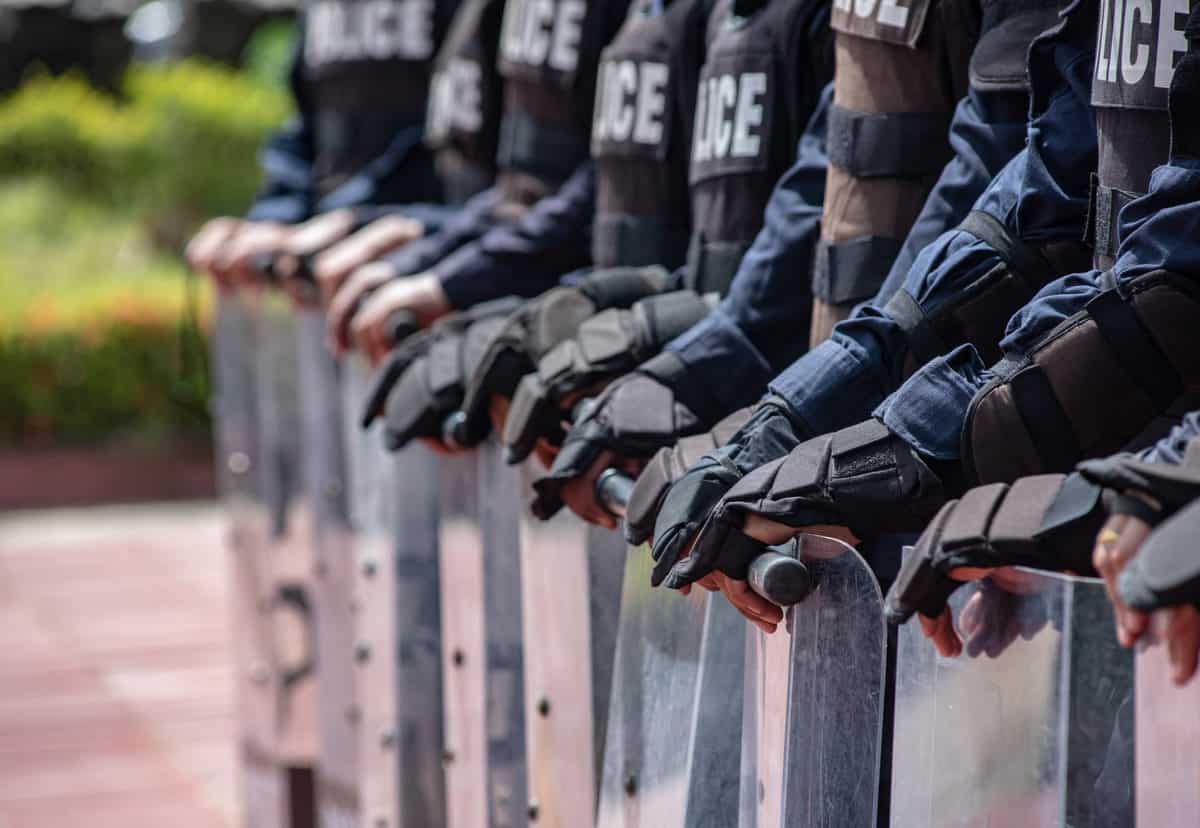
Riot police coaches review crowd control
On Independence Day, nearly a dozen black-garbed individuals, some equipped with body armor and firearms, allegedly orchestrated a premeditated ambush on law enforcement outside the Prairieland Detention Center in Alvarado, Texas. According to the federal criminal complaint, the group began firing on the center with fireworks and spray-painting anti-ICE and pro-Antifa slogans on vehicles until law enforcement moved to secure the area. Once law enforcement came out of the building, two assailants opened fire with AR-15s, firing 20-30 rounds and wounding at least one officer.
The attack was entirely foreseeable. Antifa militants motivated by virulent rhetoric have repeatedly doxxed and targeted ICE, going all the way back to Antifa member Willem Von Spronsen’s 2019 attack on a Tacoma, Washington, ICE detention facility. Spronsen was killed by responding officers and became a popular anarchist martyr.
What are these attackers seeking to achieve with their violence? Most people believe that terrorism of this sort is intended to create support from the public. But the majority of Americans, including legal immigrants, support deporting illegal aliens, especially dangerous criminals. Do Antifa militants think they can win over the public with acts of violence?
Some answers to the alleged attackers’ motivations might be found in literature captured by law enforcement. One pamphlet seized by police is entitled “Insurrectionary Anarchism: Organizing For Attack!” which was authored anonymously in 2003 (and is available online).
The pamphlet traces a history of insurrectionary anarchist thought. It begins with early anarchist thinker Mikhail Bakunin in 1871 and then goes to Luigi Galleani, an Italian-American anarchist who popularized the concept of “propaganda of the deed,” and Italian anarchist Alfredo Bonnano, whose “Why we are Insurrectionary Anarchists” is cited in its entirety.
Central to insurrectionary anarchist thinking is the notion that the violent terrorist act is simultaneously a means and an end. The attack and the propaganda are a unified whole.
The author writes, “It is through acting and learning to act, not propaganda, that we will open the path to insurrection—although obviously analysis and discussion have a role in clarifying how to act. Waiting only teaches waiting; in acting one learns to act.”
Put bluntly, the message of attempting to murder ICE agents is that ICE agents should be murdered and that others should be encouraged to do the same.
Insurrectionary anarchism contains within its logic an inherent critique of other leftist, and especially Marxist-Leninist, organizing principles. Leninists emphasize determining the “correlation of forces,” an analysis of the total historic, economic, and material differences between the warring classes before acting. Maoists seek to ensure they have the correct “mass line”—that is, remaining in step with “the people” amongst whom the Maoist guerrilla seeks to hide.
But for the insurrectionary anarchist, the events that provoke and sustain revolutions cannot truly be understood, and attempts to do so result in wasted opportunities. The author writes that
contrary to the mathematicians of the grand revolutionary parties, it is never possible to see the outcome of a specific struggle in advance. Even a limited struggle can have the most unexpected consequences. The passage from the various insurrections—limited and circumscribed—to revolution can never be guaranteed in advance by any method, nor can one know in advance that present actions will not lead to a future insurrectionary moment.
These differences in perspectives may seem like meaningless revolutionary navel-gazing to the outsider. But since the 2020 George Floyd Uprising (as they call it), there has been growing hostility between the anarchists who overwhelmingly provided the street muscle for the violent riots and the Communist Party organizers who utilized the riots to build up structures and organizations.
Read more HERE.

- Anarchists call for solidifying gains, expanding violent insurgency - February 5, 2026
- Shideler: Resistance to Immigration Enforcement Is Fierce in Minnesota - February 2, 2026
- The Revolution Is On in Minnesota - January 26, 2026