Putin’s “operation holodomor”

image generated with help of Grok AI
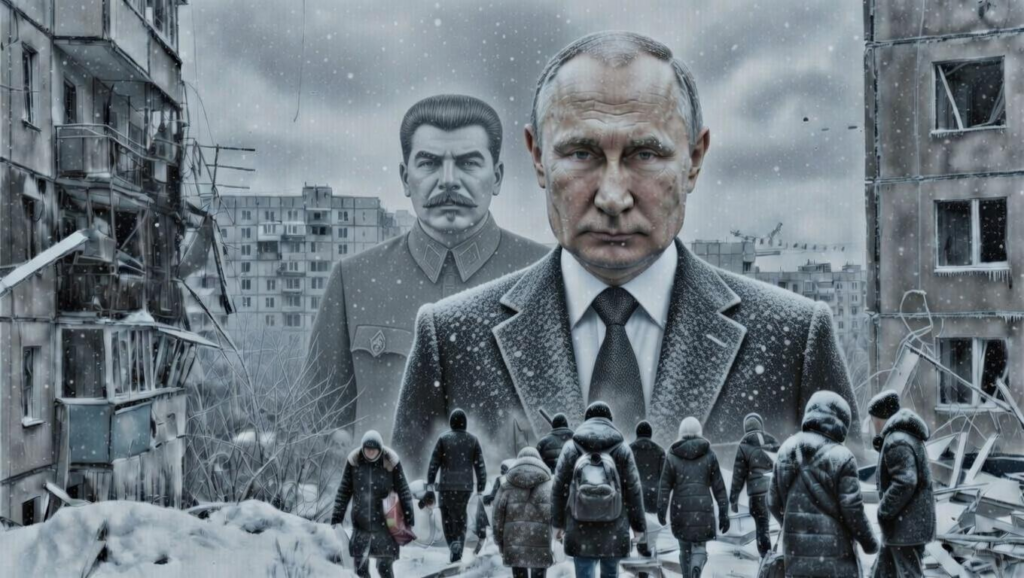
image generated with the help of Grok AI
Russia’s Attack on the Most Vulnerable Aspect of Modern Civilization Should be a Warning to the United States
The brutality of the Russian warfighting doctrine is on display in the war with Ukraine, serving as a stark warning to the United States. This doctrine inhumanely targets civilian populations for suffering and death, demonstrated by Russia’s recent operations carried out to kill Kyiv residents using cold. These relentless genocidal attacks have been dubbed “Holodomor,” a combination of the Slavic words meaning “cold” and “mass death, mass murder,” meaning “mass murder by cold”. This name itself echoes the name of the most terrible tragedy in the history of the Ukrainian people – the Holodomor in Ukrainian, the Golodomor in Russian – the murder between 3.7 and 5 million Ukrainians organized by Stalin and his communist government in 1932-1933.
Modern Human Life and Electricity
Modern civilization in the second quarter of the 21st century is completely dependent on electricity – on its production, uninterrupted supply, and the maintenance of stable voltage in the grid network.
This dependence is not unique to Ukraine. All advanced societies, especially the United States, rely on electric power in precisely the same life-critical ways. It is this interdependence that modern adversaries have studied the vulnerabilities of U.S. infrastructure for decades by employing sophisticated technologies.
The life of the modern economy, transport, services, and communication environment is impossible without electricity. Final energy consumption in the modern world economy is approximately 98% provided by electricity. The activity of almost all industry, the service sector, a significant part of agriculture, construction, transport, the communication system, information, and management – all of this can function only with a stable supply of electricity.
Human life is impossible without water for more than a few days, not more than a week. The cessation of a stable water supply leads to unavoidable death of individuals within days. Most of the modern water supply for the urban population of developed countries and a significant part of the rural population is based on the use of electricity. Therefore, a power outage in the water supply system can lead to the most severe consequences for water supply and, consequently, for the survival of large groups of people.
Human life in a cold climate is impossible without a stable heating system. The lower the outer temperature, the shorter the time before death can occur. For most people, death occurs when the body temperature drops to 70-82 degrees Fahrenheit.
The heat supply for almost all urban and a significant part of the rural population of countries located in cold climates is based on the use of electricity, as well as of thermal energy produced at power plants and combined heat and power plants of a centralized heating system.
The cessation of electricity supply in winter is especially dangerous for residents of multi-story buildings in urban areas. For them the power outage means:
– cessation of elevator operations;
– cessation of the supply of fresh water;
– if heating is provided by hot water radiators, then freezing of the water in the heating pipes, their rupture, and thus the destruction of the heating and water supply systems with possible serious damage to the buildings themselves;
– cessation of the sanitary system for the removal of human waste;
– rapid cooling of apartments to outer temperature with incoming death sentence for its inhabitants.
The situation can be further aggravated if a significant part of the population living in such multi-story buildings are elderly people with limited physical mobility and limited material ability to move to other places in particular, especially when such people have neither the financial means to move to other places of residence, nor relatives or acquaintances who are able and willing to shelter them during such catastrophes.
In conditions of consistently low temperatures that persist for a long time, the cessation of electricity supply transforms the comfortable housing of multi-story buildings, which constitute a significant part of modern urban development, into thousands and millions of cells of a colossal “concentration camp” with inhabitants doomed to death within a relatively short period.
Russia and Ukraine: A Communist Era Legacy
From 1917 through the collapse of the Soviet Union in 1991—and in many respects well beyond—Russia and Ukraine developed housing and critical infrastructure as components of a single, unified system. Electric power generation and grids, district heating, water supply, and urban residential construction were governed by identical standards, design practices, and operating assumptions. Much of the project and as-built documentation for Ukrainian infrastructure was produced by Soviet and later Russian design institutes, with extensive archives still located in Russia. As a result, Ukraine’s critical infrastructure is exceptionally transparent to Russian political and military planners.
This legacy provides Russian authorities with detailed, system-level knowledge of Ukraine’s infrastructure vulnerabilities. While some weaknesses are universal to electric power systems, Russia’s familiarity with Ukraine’s specific layouts, interdependencies, and failure modes enables precise, selective strikes designed to trigger cascading disruptions and delay restoration rather than indiscriminate destruction.
These technical realities have direct humanitarian consequences in Kyiv. By early 2026, the city and its agglomeration with more than 4 million residents (as of 2024) contained more than 12,000 multi-story buildings of 5 stories or more, including nearly 1,200 residential structures of 12 stories or more, housing a population swollen by wartime displacement. This dense, vertical urban environment is acutely dependent on uninterrupted electricity for heat, water, elevators, and communications, and medical care. Attacks on power infrastructure serving these areas therefore impose predictable and disproportionate harm on civilians, reflecting deliberate exploitation of urban energy dependence rather than incidental collateral damage.
Putin’s “Operation Holodomor”
Following mild cool weather in late November and December 2025, and in early January 2026, the hydrometeorological services of Ukraine and Russia forecasted a sharp decline in air temperature to +5°F to -4°F for at least three weeks starting from January 8-9, 2026. Seizing this opportunity on the night of January 8-9, 2026, when the air temperature in Central Ukraine dropped to -4°F, Russian troops carried the first in a series of brutal attacks, targeting the power and heating systems of Kyiv and the Kyiv region. The attack involved 242 drones and 42 ballistic missiles, including 22 Kalibr cruise missiles.
As a result of the attack, 4 people were killed and 19 were wounded. Damage to critical infrastructure disrupted electricity, heating, and water supply to more than 6,000 (more than half) of Kyiv’s multi-story buildings.
Kyiv Mayor Vitali Klitschko announced that utility services had begun draining water from heating systems to prevent irreparable damage to pipelines. He also urged all Kyiv residents who had such an opportunity to leave the city immediately and move to other locations. In the following days, more than 600,000 residents left Kyiv. Over the course of the next days, Ukraine utility services worked round-the-clock to restore power and heat – only to have Russia once again target civilians, including the elderly, women and children.
On the night of January 11-12, Russian troops launched a new attack on Kyiv’s critical infrastructure. The attack involved 293 drones and 25 ballistic missiles. After the new shelling, the electricity shortage in Kyiv worsened, even for critical infrastructure. Energy workers continued to work around the clock.
Again, just as power and heat were nearing restoration, on the night of January 19-20, Russian forces launched a new attack on Kyiv’s critical infrastructure. The attack involved 339 drones and 34 ballistic and cruise missiles, and by 9:00 AM on January 20, 5,635 multi-story buildings were without heating. Almost 80 percent of these were buildings where heating had been restored after the Russian attack on the night of January 8-9.
On the night of January 23-24, Putin’s Holodomor strategy continued as Russian troops launched a new attack on critical infrastructure facilities in Kyiv. The attack involved 351 drones and 21 missiles of various types.
By 10:00 AM on January 24, more than 6,000 multi-story residential buildings were again without heating. Many of these were the same buildings that had lost heating as a result of the attacks on January 9 and 20, and for which heating had been restored in the following days.
On the night of February 2nd-3rd, the air temperature in Kyiv dropped to -4°F, a situation that Putin exploited by launching another massive attack on Kyiv electric and heating infrastructure. This attack was the most brutal during the entire four-year large-scale phase of the 12-year open Russian aggression against Ukraine. The attack involved 450 drones and 71 missiles of all types. Within a day, 1170 multi-story residential buildings in Kyiv were left without heating and to avoid serious damage to the heating systems, Kyiv utility services drained the water from the heating systems in 1100 buildings.
The deliberate, repetitive nature of these attacks demonstrates a doctrine designed to weaponize civilian dependence on electricity – a doctrine that Russia and other adversarial states have closely examined in the context of their own planning against Western Power systems – especially the United States.
A Warning for the United States
The evidence thus presented leads to a stark and unavoidable conclusion that modern adversaries do not view electric power systems as neutral infrastructure or collateral damage. They view them as primary targets. Russia’s campaign against Ukraine demonstrates that attacks on the electric grid are, in effect, attacks on the civilian population itself. Electricity is the enabling system for heat, water, medical care, sanitation, communications, and survival in modern urban society. When the grid is targeted, civilians – men, women, children, the elderly, and the infirm – are the intended victims.
The suffering of the Ukrainian people illustrates how thoroughly this doctrine has been operationalized. Russia’s detailed knowledge of Ukraine’s infrastructure, combined with its willingness to strike during extreme winter conditions, reveals a form of warfare that deliberately transcends the battlefield. This war doctrine is not an intended to degrade military capability; it is an assault on the basic conditions of civilian life. The repeated, timed attacks on power and heating systems in Kyiv underscore a calculated strategy to exploit infrastructure dependence to impose fear, displacement, and mass hardship.
This reality carries urgent implications for the United States. In the United States, this risk is compounded by decades of cyber penetration and the widespread use of foreign sourced hardware and software within the grid, creating opportunities not only for persistent long-term cyber reconnaissance, intelligence collection, and the systematic probing of grid control systems but for latent, remotely triggered disruption by foreign adversaries like Russia.
For example, the late George Cotter – a 40-year veteran of the National Security Agency (NSA) issued the following warning to the U.S. Federal Energy Regulatory Commission in September 2019:
“The Russian Ministry of Defense GU has had unimpeded access to the BPS (U.S. Bulk Power System) since at least 2012. It has collected all the infrastructure information it needs to attack the BCS for access to Distribution systems serving major urban and National Security facilities; (most of the latter mere extensions of Distribution facilities.) It has developed from those collections potent attack systems, thoroughly tested in the Ukraine.”
Cotter further concluded that the U.S. bulk power system “hasn’t suffered any outage” due to cyberattack is “totally due to Russian restraint.”
The lesson for America is not abstract, nor is it theoretical. It is being written in real time in Ukraine, in the suffering of millions of civilians whose only vulnerability is their dependence on electricity to live.
The United States must take this lesson seriously. Protecting the electric grid is not simply an engineering challenge or an industry concern – it is a matter of civil defense, national resilience, and the protection of human life.
Russia’s “Holodomor” operation against Ukraine underscores why grid protection and preparedness in the U.S. must become a national priority – and before Russia’s “restraint” runs out.

- Putin’s “operation holodomor” - February 12, 2026
- Gridlock: why America’s power supply is in danger - February 11, 2026
- “Within 72 Hours, the American Population Will Break Down”: Lt. Col. Tommy Waller - January 8, 2026