US military’s Iran war pivot forces Asia-Pacific security rethink – CSP Senior Fellow, Grant Newsham, quoted

Originally published by South China Morning Post
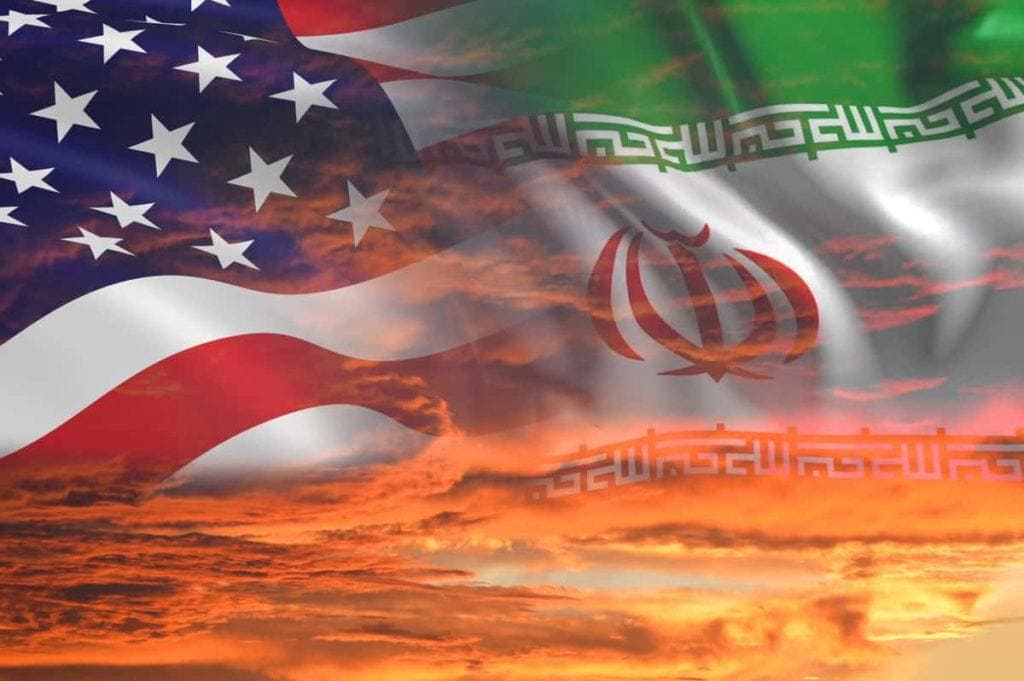
USA United States of America and Iran relations / iran us war with flags on stormy cloudy orange sky background
As assets are diverted to the Gulf, the Iran war’s high ‘burn rate’ risks creating a ‘thin spot’ in the US security umbrella
The redeployment of US military assets from the Asia-Pacific to the Middle East has split security analysts, with some arguing that any strategic damage is largely “psychological” while others warn of a real and measurable gap opening in the region’s defences.
More than 2,000 marines and at least one amphibious assault ship have begun moving from Japan towards the Gulf as the US-Israeli war on Iran grinds on. The assault ship USS Tripoli, docked at Sasebo in Nagasaki prefecture, is expected to reach the Middle East within one to two weeks.
The redeployment comes as maritime traffic through the Strait of Hormuz – the narrow chokepoint through which roughly 20 per cent of the world’s crude oil typically flows – has come to a standstill amid Iranian attacks on shipping.
“The US still has plenty of combat power in the region and its basic military presence, including air and naval assets, is largely intact.”
Newsham did acknowledge, however, that removing military assets from one area was likely to “leave a ‘thin spot’ in another”.
The “burn rate” of American munitions in the Iran war is another concrete measure of strain, according to security researcher Paul Midford, a professor of international politics at Meiji Gakuin University in Yokohama.
Within the fi rst four days of the war, 10 per cent of Washington’s global Tomahawk stockpile had already been consumed, he said.
“The high burn rate of THAAD and Patriot air defence missiles hollows out the US military posture in East Asia, even in the case of missiles coming from the US and Europe,” Midford said.
Japan ordered 400 Tomahawk missiles from Washington in 2024, but with the US burning through its supply far faster than it could manufacture replacements, he said most of that order would be delayed “well beyond this year”.
For regional defense planners, the implications are clear: expect more delays on promised US equipment, according to Midford.
Similar concerns emerged when the Ukraine war began to drain American weapons stocks, he said.
‘Limited capacity’
The latest US redeployment has also reopened long-standing questions about how much say Japan actually has over American forces operating from its soil.
Under the US-Japan Security Treaty, signed in 1960, Washington is required to consult Tokyo before making major operational changes involving its forces in Japan.
But that mechanism is now “effectively dormant”, according to Yasuo Takao, a political scientist and international relations specialist at Curtin University in Australia, allowing US bases “to be used freely for operations unrelated to Japan’s direct defense”.
Tokyo had only a “limited capacity” to infl uence Washington’s strategic choices, he said.
Nowhere is that tension more visible than in Okinawa. The prefecture hosts around 26,000 US military personnel – roughly half of all American forces in Japan – and contains 70 per cent of US military assets on Japanese soil, despite accounting for less than 1 per cent of the country’s land area.
Takao described Okinawa as functioning less as a defensive shield for Japan than as a “regional expeditionary platform” within America’s global military network.
“This reinforces long-standing local grievances that the prefecture disproportionately bears the burdens of the alliance while having limited infl uence over how the bases are used,” he said. Those grievances largely relate to the impact of
hosting bases, such as safety concerns, environmental damage and criminal incidents involving US personnel.
Against this backdrop, Japan is accelerating its own defence build-up.
Defense Minister Shinjiro Koizumi said on Friday that the confl icts in Ukraine and Iran had made a major update to Japan’s security strategy necessary, with a focus on drone technology, enhanced surveillance and improved stand-off strike capabilities – all while maintaining defense spending at 2 per cent of gross domestic product.
Newsham said Tokyo was already buying and building more ships, aircraft and unmanned vehicles, expanding its surveillance networks and acquiring long-range missiles to counter what he called “the overwhelming Chinese, North Korean and Russian missile forces targeting Japan”.
Improvements in joint capability – both within the three branches of Japan’s military and with US forces – amounted to a “huge force multiplier”, he added.
Midford said Japan was also weighing the acquisition of nuclear-powered submarines as its strategic focus has shifted.
Rather than concentrating on the southwest of the Japanese archipelago and the contested Diaoyu Islands, known in Japan as the Senkakus, he said Tokyo was increasingly turning its attention to the Pacifi c coast, where it planned to strengthen its airbase and military presence on Iwoto, known internationally as Iwo Jima.
That pivot refl ected “growing uncertainty about US reliability as a military ally”, Midford said – adding that South Korea shared the same doubts and was actively exploring the possibility of acquiring nuclear weapons.

- ‘Ironic’ that Pakistan should offer to host US–Iran peace talks - April 1, 2026
- The postwar Japan Constitution: a ‘get out of jail free’ card - March 31, 2026
- Grant Newsham appeared on The John Batchelor Show to explain the deployment of Marine Expeditionary Units to the Persian Gulf - March 26, 2026