President Trump takes a stand against Sharia
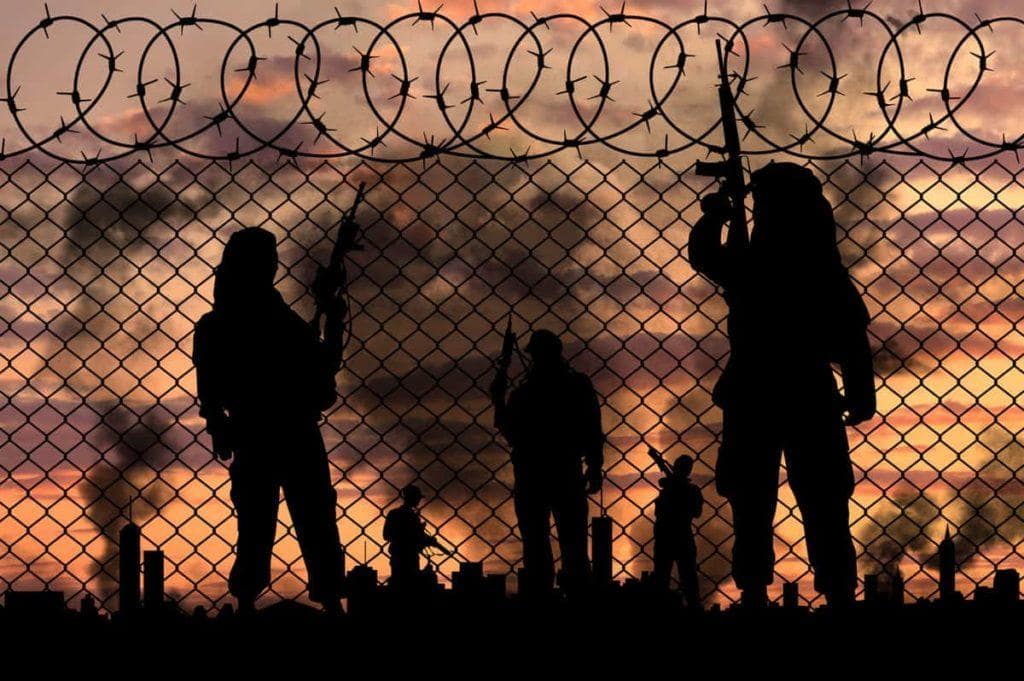
Concept of terrorism. Silhouette terrorists near the border fence in the background on the city in smoke at sunset

On 26 August, in a telephone interview on the Glenn Beck program, President Trump took a bold stand that no president before him would even address. He said he would support a ban on sharia in the United States:
“I would absolutely prohibit the Sharia Law thing, and it is happening in this country a little bit. And where we see it, we take it out. And you have to take it out. You have ONE system. We have a great system. Sometimes it’s very frustrating, but it’s the best there is that I can see.”
It’s refreshing to say the least to hear a president acknowledge that sharia has no place in America and President Trump’s statement should embolden lawmakers at the congressional and state level to act on this issue, not just because sharia inherently violates many of our constitutional principles, but also because sharia is the enemy threat doctrine of organizations such as Al Qaeda, ISIS, Hamas, Hezbollah, Boko Haram, Al Shabaab, the Muslim Brotherhood, Lashkar e Taiba, the Taliban and every other Jihadist organization in the world.
That said, legislators across America who act on President Trump’s stance must take a thoughtful and comprehensive approach to protecting America from sharia.
There is No “Silver Bullet”
Unfortunately, as many lawmakers who have researched the subject have already discovered, tackling this problem is not as simple as one might initially think.
First of all, while sharia is a legal and political ideology in addition to being a form of religious law, we cannot hold sharia off by politics and policy alone. This is a spiritual battle. All we have to do to realize this is to look to Europe and what has happened there as sharia has creeped into not just their legal systems, but also their cultures. That has happened largely because much of Europe has long ago become spiritually bankrupt.
If you log onto YouTube and enter the search term “church converted to mosque,” you will find numerous videos of churches in the United Kingdom, France and elsewhere in Europe that have been shuttered and turned into mosques. This is a result of the spiritual withering of Christendom in those nations. That is what made them vulnerable to the creeping sharia and Islamization that has allowed sharia mores like polygamy, child marriage, cousin marriage, female genital mutilation, and intolerance of other faiths and lifestyles to take hold in Europe, as well as allowing the Jihadist terrorist elements, such as ISIS, Hamas and Hezbollah, to begin flowering there.
In contrast to western Europe, eastern European nations such as Poland and Hungary, where Christianity is still robust, have been little impacted by what we have seen to their west.
There are certainly lessons in this for America and, though spirituality is vital, we are a nation of laws and we must pass new laws to protect us from sharia and also enforce existing laws that are well-suited to combat against sharia practices.
How to Protect America from Sharia
The first aspect of understanding how to battle back against sharia is to realize that no single law or “ban” will inoculate America against sharia.
One of the most widely distributing texts of “Islamic Sacred Law” is Reliance of the Traveler, which holds the endorsement of Al Azhar University, considered the premiere sharia educational institution in the Islamic world.
Reliance of the Traveler is over 1,200 pages long.
Another authoritative text is A Summary of Islamic Jurisprudence published in Saudi Arabia and authored by Dr. Salih Al-Fawzan, a professor of Islamic Jurisprudence and a Member of the Board of Senior Ulema & Member of the Permanent Committee for Fatwa and Research.
A Summary of Islamic Jurisprudence includes two volumes which, combined, are made up of over 1,300 pages.
Sharia (and these textbooks) covers all aspects of life, personal, legal, political and financial. Everything from codes of dress, human interaction, property rights, taxation, alms giving, the conditions under which an Islamic state would go to war, criminal punishments, specific rules for non-Muslims under sharia and more are covered in detail.
This is why no blanket ban on sharia would work. We must go after the practices and aspects of sharia that are toxic to our fundamental constitutional rights.
We cannot outlaw ecclesiastical rules for prayer for any religion, those are protected by our constitution’s 1st Amendment. A significant portion of sharia falls into categories such as this.
On the other hand, some toxic sharia practices, such as violent jihad, material support for terrorism, cruel and unusual punishments, child marriage and polygamy are already prohibited under existing state and federal law.
However that does not mean that we should not amend those laws to put a finer point to them to address them in view of evolving threats. Such modifications are in the works ready to be filed in state legislatures. Moreover, even where and when existing laws are sufficient, often law enforcement and criminal justice authorities are unaware of the practices that may be occurring in their jurisdictions and are thus ill-equipped to address them. Education of law enforcement is key.
Keeping Sharia out of our Courts
One of the chief ways in which sharia infiltrates a host legal system is through disputes that arise in the court system, particularly in the area of family law. There have been two types of efforts to prevent this, one which was unsuccessful and the other which has been working successfully for 15 years in several states.
On Monday, September 12, 2011, the Federal 10th Circuit Court held a hearing on the constitutionality challenge to an Oklahoma state constitutional amendment which passed overwhelmingly in November of 2010, to prevent courts in Oklahoma from using international law or sharia law in their decisions.
The amendment was referred to officially as State Question 755 (SQ 755).
This well-meaning measure seemed reasonable at first glance and was hailed in conservative political circles as a step in the right direction to preserve American sovereignty and prevent the incorporation of sharia law into American courts and institutions.
The amendment’s authors wanted, rightly, to prevent the European mistake of allowing parallel sharia court systems. And 70% of the Oklahoma electorate supported the bill’s principles of preventing “foreign laws in general, and Islamic Sharia law in particular, from overriding state or U.S. laws.”
But first glances can be deceiving. In fact, the reality was very different.
Unfortunately, SQ 755 had the opposite of its intended effect. It proved to be a boon to its opponents, and a distraction from the more carefully drafted bills designed to prevent both the entry of unconstitutional foreign laws such as sharia in American jurisprudence
as well as the use of transnationalism by activist judges.
SQ 755 contained several flaws, some legal and some practical. The legal flaws were exposed in the federal courts, which effectively quarantined the amendment from being implemented. Here is a summary of the two key flaws in SQ 755:
• SQ 755 was not facially neutral, because it specified sharia law. This violated equal protection and ran afoul of the establishment clause of the US constitution.
• Practically speaking, SQ 755 was defective in its aim to prevent the enforcement of sharia in America. The amendment banned the use of sharia in decisions without defining what sharia was. Judges in the U.S., Oklahoma being no exception, are not generally educated or informed about sharia. They cannot be expected to recognize sharia. If a question arises in a case as to whether some aspect of a conflict comprises sharia or not, a judge will be forced to consult an outside expert or source to make a determination. In almost every circumstance, that outside expert or source will end up being a sharia scholar or the work of a sharia scholar. So, ironically, the very law that is designed to prevent sharia from working its way into our legal system will have invited sharia experts in to make rulings.
After the federal ruling, which was originally handed down by a Reagan-appointed federal judge, SQ 755 gave ammunition to proponents of sharia and transnationalism, who pointed to 755 as “proof” that any law designed to prevent the incursion of foreign laws and foreign
legal doctrines into state courts in the United States is unconstitutional, or will be subject to expensive legal challenges from groups such as the Muslim Brotherhood-tied Council on American Islamic Relations (CAIR) or the judicial activist/transnationalist ACLU.
Fortunately, legislation that meets these tests has been developed and passed into law in Tennessee, Louisiana, Arkansas, Kansas, Mississippi, Alabama, North Carolina, Oklahoma, Florida, Arizona, Washington, Missouri, Idaho and Indiana. That legislation is American Laws for American Courts (ALAC).
American Laws for American Courts has not incurred any legal challenges in any state where it has passed into law because there is simply no legal basis on which to challenge it. This is significant because SQ 755 was challenged in federal court within days of passage.
American Laws for American Courts is the absolute gold standard in that its language is the also detailed and complete, with specific instructions for implementation to prevent activist judges from overreaching constitutional authority.
Explicit references to “Sharia law” and religious law in draft legislation raises potential
constitutional concerns that the Model American Laws for American Courts law avoids. The Model American Laws for American Courts law intentionally uses neutral language referring to “foreign law” rather than identifying any particular religious or cultural legal system. This neutral drafting approach helps ensure that the statute regulates legal mechanisms (such as foreign law in court proceedings) rather than targeting religion. By contrast, repeated references to Sharia or religious law invites trouble. Because much of sharia has been regarded as a religious legal tradition associated with Islam, singling it out in statutory language has already raised questions under the First Amendment’s Establishment Clause and Free Exercise Clause, which prohibit government actions that discriminate against or single out religion for disfavored treatment. Lest you worry that sharia might not be regarded as “foreign law,” it has in U.S. state jurisprudence.
Courts analyzing statutes that appear to target religion have already applied heightened scrutiny to determine whether the law is neutral and generally applicable. A statute that explicitly names a religious legal system can and has been challenged as demonstrating religious animus or lack of neutrality, particularly if the law’s structure suggests it was enacted to disfavor one faith. For this reason, the Model American Laws for American Courts law was drafted to address the underlying constitutional concern – protecting litigants from the application of foreign law that violates fundamental constitutional rights.
Patriotic Americans should all share a commitment to the Constitution and the determination to prevent that founding document from being weakened or eviscerated by foreign laws, including sharia, to ensure that American laws are practiced in American courts.
Just as importantly, state legislatures should work to address aspects of sharia that are toxic to our culture, society and public safety such as:
• Prohibitions of female genital mutilation
• Material support for terrorism
• Violent jihad
• Child marriage
• Polygamy
• Cousin marriage
• Subversion and sedition
• Discriminatory practices
• Violations of freedom of speech and free expression
• Intimidation and violations of free practice of religion
For more information on any of these aspects of countersharia and counterjihad legislation or education and law enforcement training, please contact me at [email protected].

- President Trump takes a stand against Sharia - August 27, 2026
- A Very Concerning Poll from Pew - August 12, 2026
- America at 250 - July 2, 2026