Senior Fellow Robert Spencer testifies before Congress: why the Constitution and Sharia are incompatible
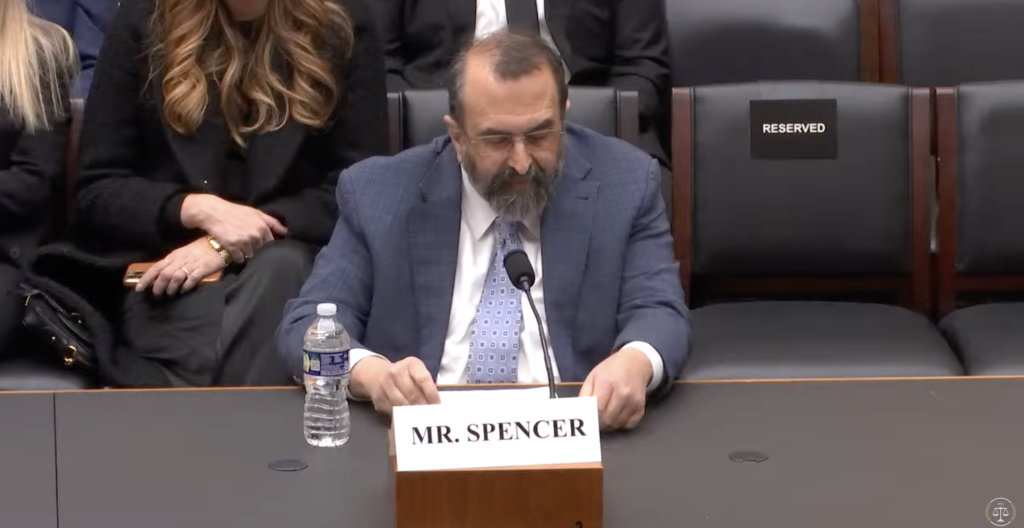

Robert Spencer
Testimony before Subcommittee on the Constitution and Limited Government
February 10, 2026
The US constitution and Sharia are incompatible, and the conflict between the two legal systems will grow as Sharia adherents increase in number in the West. This fact has been obscured by misinformation about what Sharia is. When the city of Keller, Texas scrapped an anti-Sharia resolution in January 2026, the Council on American-Islamic Relations, CAIR, stated that “like canon law for Catholics and halacha for Orthodox Jews, sharia refers to the rules that Muslims follow, including praying five times a day, fasting in Ramadan, giving in charity, and following the laws of the land in which they live.”
If that were really all that Sharia was about, no reasonable person would have any problem with it. CAIR doesn’t mention, however, that Sharia is inherently political, supremacist, expansionist, and violent. Far from being the “Islamophobic conspiracy theories” of CAIR’s imagining, these are facts that Muslim authorities on Sharia openly attest.
Reliance of the Traveller, or Umdat al-Salik, is a classic manual of Islamic sacred law, that is, Sharia. In 1990, Dr. Taha Jabir al-Alwani, President of the International Institute of Islamic Thought and president of the Fiqh Council of North America, stated that this Sharia manual was useful as “a textbook for teaching Islamic jurisprudence… or as a legal reference for use by scholars, educated laymen, and students.”
The most prestigious institution of Islamic learning in the world, al-Azhar in Cairo, stated in 1991 that the same manual of Sharia “conforms to the practice and faith of the orthodox Sunni Community.”
We read in this guide to Sharia that “Jihad means to war against non-Muslims,” and that jihad is a communal obligation upon the Muslim community. When a Muslim land is attacked, even in defense against its aggression, it becomes personally obligatory upon every Muslim. The object of this war is to establish the hegemony of Sharia over the conquered land. For non-Muslims, this means an institutionalized, highly codified second- class status that denies them basic rights.
Non-Muslims living under Sharia must “pay the non-Muslim poll tax (jizya)” that is specified in the Qur’an. This religion-based tax is designed to indicate, as the renowned Islamic scholar Ibn Kathir explained, that the non-Muslims who are paying it are “disgraced, humiliated and belittled.”
The non-Muslims in this state of disgrace and humiliation are not allowed to build new houses of worship or repair old ones, so their communities are in a perpetual state of decline. They are forbidden to make any public display of their religion. They are relegated to the most menial jobs in society, for they are forbidden to hold authority over Muslims. If they say anything critical about Islam, Muhammad, or the Qur’an, they are liable to be put to death.
From all this it is clear that Sharia is not simply Muslim personal religious law. On the contrary, Sharia law-based legal and civic institutions are contrary to America’s founding principles and may violate federal law and the Constitution.
The death penalty for mentioning what Reliance of the Traveller terms “something impermissible about Allah, the Prophet, or Islam,” that is, blasphemy, is directly at variance with First Amendment protections of the freedom of speech. The Islamic imperative to establish the hegemony of Sharia as the law of the land, as it is today in the Islamic Republic of Iran, Afghanistan, and elsewhere, is at variance with the First Amendment principle that the United States will not have an established religion.
Even in its personal aspects, Sharia contradicts U.S. law. The Qur’an states that a man should “beat” a woman from whom “he fears disobedience.” Domestic violence is a crime in U.S. law, but it is not a crime under Sharia. Britain began establishing Sharia courts several years ago, with the understanding that cases that came under the purview of British criminal law would be referred to the British courts. Instead, the Muslim Arbitration Tribunal on its website urged the Crown Prosecution Service to “reconsider” bringing criminal charges brought against Muslim men who had been accused of domestic violence.
This was no aberration. As Sharia is considered divine law, those Muslims who adhere to it consider it always to take precedence over the laws of the land.
Moreover, emigration to a new land to bring Sharia to it is also an Islamic imperative. The Qur’an promises a reward from Allah to those who “emigrate for the sake of Allah,” which means for the purpose of bringing Sharia to a non-Muslim land. Thus the conflict between Sharia and the U.S. Constitution will only grow as the Muslim population in the U.S. grows, for among that population will always be some Muslims who take these imperatives with the utmost seriousness.

- Senior Fellow Robert Spencer testifies before Congress: why the Constitution and Sharia are incompatible - February 11, 2026
- Hezbollah wants a ceasefire now. Here’s why Israel shouldn’t give them one. - October 17, 2024
- Media heaps praise on slain Hezbollah top dog Nasrallah - October 9, 2024