When Russian drones show up in North Korea
This piece, originally published by Asia Times, was authored by CSP Senior Fellow Stephen Bryen.
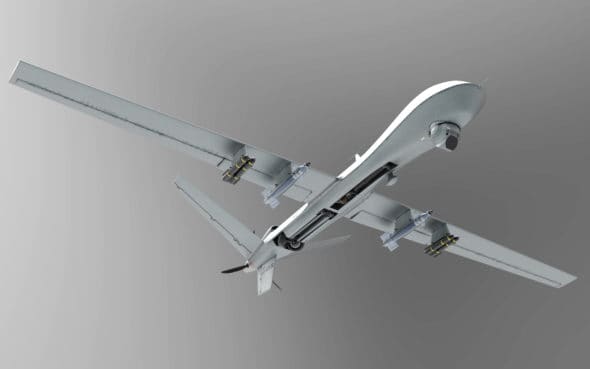

North Korea is sending increasing numbers of workers to Russia’s premier drone factory located at the Alabuga Special Economic Zone. Alabuga is located in the Yelabuzhsky District of the Republic of Tatarstan, Russia.
The Yelabuga Drone Factory produces Geran drones (Geran 1, Geran 2, Geran 3 and Geran 5). There is strong speculation that North Korea will soon get Russian drones, impacting the balance of forces on the Korean peninsula.
No one yet knows whether Russia will sell the drones to North Korea or if North Korea will acquire production technology from Russia.
Surely the Russians know that North Korean workers do more than solder parts together. Among them are well-trained spies.
The Yelabuga drone factory comprises interconnected manufacturing buildings, testing structures, security perimeters and specialized storage magazines, and spans over 2.8 million square meters.
The facility originally started in 2023 by assembling knock-down kits imported from Iran. It has since transitioned into an indigenous manufacturing pipeline producing entire airframes, engines, and internal electronics locally.
The factory operates 24 hours a day and produces thousands of long-range attack drones per month (with independent estimates pointing to production capacities reaching or exceeding 5,500 units monthly.)
The factory today has close to 40,000 workers. Of these, 12,000 to 25,000 workers (many of them women) are from North Korea.
The workers from North Korea are sent to Russia on student visas, a workaround as UN sanctions do not allow the transfer of North Korean workers to Russia (or China), or to other countries. However, the sanctions do not apply to students. Student visas for Russia are laundered in Moscow.
While North Korea sends more workers to China than to Russia, the Chinese have kept North Korean workers away from the defense sector and have run heavy surveillance on North Koreans working in IT (information technology) in China. In at least one publicized case, China arrested a North Korean IT worker, accusing him of espionage.
Russia is operating on a war-manufacturing footing, but is short of factory-line workers. According to the Carnegie Endowment, estimates of Russia’s overall worker shortage range between 1.5 million and 2.6 million unfilled positions, with unemployment hovering at historic lows of around 2%.
The Ukraine war has drained Russian industry of a significant part of its workforce. Workers recruited into the armed forces (either by conscription or under contract), plus the high number of soldiers either killed or wounded, have exacerbated the employment situation, compounded by thousands of young people who fled the country in 2022 to avoid serving in the army.
Until recently, the Geran 2 drone was the most important one-way attack drone in Russia’s arsenal. They are used heavily in mixed-swarm attacks in the war in Ukraine. This past March, a Geran 2 was shot down by the UAE, demonstrating that Russia was secretly supplying Geran drones to Iran. The latest iteration in the Geran series is the Geran 5.
This drone uses a turbojet engine and travels at 600 kilometers per hour (373 mph), rendering the drone immune to slower Ukrainian interceptor drones such as the Wild Hornets Sting or the Alexa Spatium. Geran 5 carries a 90-kilogram warhead (Geran 2 is around 50 kg) and is semi-autonomous. Reportedly, the engine is China’s TeleflyTF-TJ2000A.
Read more HERE.

- When Russian drones show up in North Korea - October 8, 2026
- RAF Fairford big-scale attack try represents serious threat to US - September 29, 2026
- The Ukraine negotiations and Ukraine’s future - September 16, 2026