If the Iranians want a deal they have a funny way of showing it

Originally published by AND Magazine
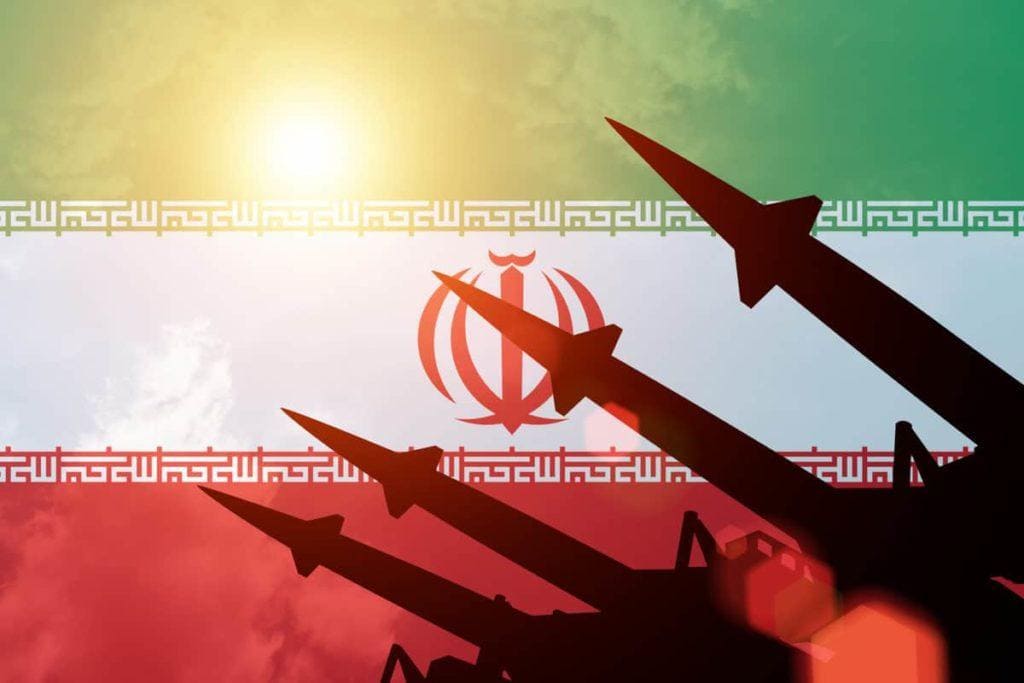
Antiaircraft rockets silhouettes on background of Iran flag. Sunny.
“I view it as very close to over,” says President Trump, referring to the Iran war.
“They’d like to make a deal very badly.”
If so, the Iranians aren’t saying so.
In remarks made on Wednesday, Ali Abdollahi, the commander of Iranian Khatam al-Anbiya Central Headquarters, emphasized that if the US continues its illegal maritime blockade and creates insecurity for Iranian commercial vessels and oil tankers, it would be a violation of the ceasefire agreement. He added that Iran’s military forces would not allow any exports or imports to take place in the Strait of Hormuz, the Persian Gulf, the Sea of Oman, or the Red Sea.
In an article published on April 15, 2026, Hossein Shariatmadari, editor of the regime mouthpiece Kayhan, called on the American people to assassinate President Trump. He also claimed that Trump raped children and ate their flesh.
On April 8th, the Iranian Embassy in Tajikistan published a video showing Trump waving a white flag and surrendering to Iran.
The same day, the Iranian Embassy in India published an image showing Trump bowing down to a bas-relief image of an ancient Persian warrior.
Over the next several days, Iranian Embassies around the world published similar images or statements, accusing the United States of begging for a deal and labeling Trump a “terrorist”.
On April 13, 2026, the former Deputy Foreign Minister of Iran gave an interview on Iranian television in which he called any negotiations with the United States a “big mistake” and vowed Iran would never give up its nuclear program.
The same day, in response to the American declaration of a blockade of the Straits of Hormuz, Ebrahim Rezaei, a spokesperson for the Iranian parliament’s National Security Commission, dismissed the blockade of Iran as “more bluffing than reality.” “It will make the current situation (Trump) is in more complicated and makes the market — which he is angry about — more turbulent,” Rezaei said in a post on X.
The Iranian parliament speaker, Mohammad Bagher Qalibaf, also addressed Trump in a statement saying, “If you fight, we will fight.”
Meanwhile, Iran’s representative to the United Nations, Amir-Saeid Iravani, demanded compensation from five Middle Eastern countries — Bahrain, Saudi Arabia, Qatar, Jordan, and the United Arab Emirates, which Iran says violated international law by aiding the war effort against it.
Shortly after the U.S. blockade took effect on April 13th, IRGC spokesman Sardar Mohseni and military spokesperson Ebrahim Zolfaghari stated that “no port in the Persian Gulf and the Sea of Oman will be safe” if Iranian shipping or ports are threatened. They described security in the area as “for everyone or for no one” and vowed to introduce “new methods of warfare” that opponents would have limited ability to counter.
On Wednesday, Mohsen Rezaee, the former commander of the Iranian Revolutionary Guard Corps, mocked President Trump on state TV, claiming he wants to be the “police” of the waterway before boasting that Tehran’s missiles can take out American vessels.
“These ships of yours will be sunk by our first missiles and have created a great danger for the US military. They can definitely be exposed to our missiles, and we can destroy them.”
“Unlike the US, which fears prolonged war, Iran is fully prepared and experienced in long-term war.
“Unlike previous talks where the other side set the terms, Iran is now setting the preconditions.”
Rezaee then vowed that Iran “would take thousands of hostages and for each hostage we would get a billion dollars.”
Meanwhile, videos are circulating online purporting to show Iraqi Shia militia members on the streets of Tehran enforcing order. The videos show armed men in black tactical gear patrolling Tehran’s night streets. Opposition accounts claim the militia members have been brought in to support Iran’s regime.
There are also unconfirmed reports online that Iran is clearing the entrances to so-called “missile cities” buried by American and Israeli attacks. This activity is claimed to be in preparation for renewed fighting after the expiration of the ceasefire.
Press TV – Iranian State Media – April 13, 2026
Speaking on Iranian state television on April 16, 2026, Brigadier General Alireza Sheikh, the deputy Chief of Staff of the Iranian Armed Forces, said Iran had increased the production rate of attack drones tenfold over the last seven months and characterized the fighting so far as a “great victory”. Iranian state media also claims that damage to key infrastructure is now being repaired.
Certainly, much of what Iran says is puffery and intended for domestic consumption. We can also hope that what we are seeing is largely intended to enhance Iran’s position in any future negotiations. We would be wise, however, to consider that not all of this is “trash talk”. If the Iranians want a deal, they certainly have a funny way of showing it.
