Center’s Shideler testifies before Senate on Muslim Brotherhood
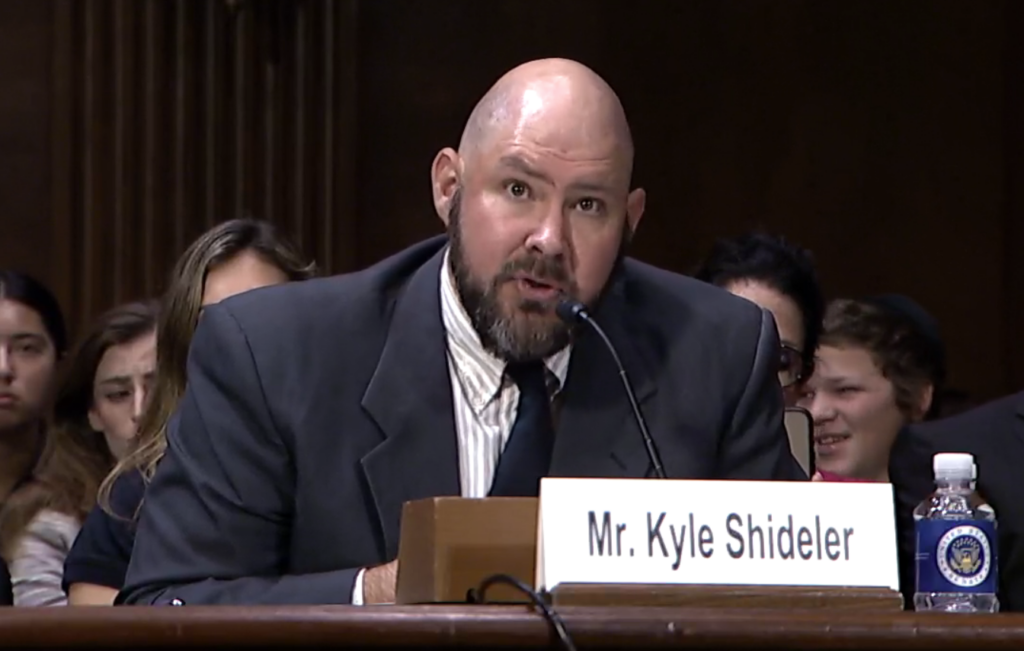

Testimony of Kyle Shideler
Director and Senior Analyst for Homeland Security and Counterterrorism, Center for Security Policy
August 5, 2026
Before the Subcommittee on Federal Courts, Oversight, Agency Action and Federal Rights, Senate Committee on the Judiciary
Chairman Cruz, Ranking Member Whitehouse, Distinguished Senators:
I would like to thank you for the opportunity to testify today on this important topic.
Because our court system is built on certain fundamental principles—including trial by jury, the government’s burden of proof in criminal matters, and the right to confront one’s accusers—courts both civil and criminal have been at the center of revelations of great consequences to our republic and its national security.
Examples include the Chamber-Hiss case and its famous “Pumpkin Papers” exposing the role of the Communist Party of the United States in Soviet espionage, or the trials surrounding the 1957 Apalachin, New York raid, which convinced federal law enforcement of the existence of the American Mafia. To these we must add United States v. Holy Land Foundation for Relief and Development, prosecuted almost two decades ago, which exposed the existence and extensive reach of the Muslim Brotherhood in America since its arrival in 1962.1
The evidence submitted during that trial demonstrated that not only was the Muslim Brotherhood operating in America, but that the Brotherhood played a singularly important role in providing indoctrination, financing, and political protection for jihadist terror.
Founded in Egypt by Hassan Al-Banna in 1928, from its very beginning the Muslim Brotherhood operated as a clandestine organization, which engaged in the creation of public front groups, cultivated agents of influence, sought control over religious institutions, engaged in acts of political subversion, and created deniable sub-organizations devoted to terrorism, in pursuit of its ultimate goal, the overthrow of governments and the reestablishment of a worldwide caliphate operating under Islamic law, known as Sharia.2
It is worth recalling that the government demonstrated that the U.S. Muslim Brotherhood, like all Brotherhood branches worldwide, created and funded Hamas support networks—known as Palestine Committees—at the direction of the International Muslim Brotherhood beginning in 1983.3
In 2018, the U.S. government designated the Hasm Movement and Revolution Brigade (Liwa Al-Thawra), two Brotherhood-created terror groups founded to fight the Egyptian government. So this policy of forming and spinning off terror groups has remained fundamental to who the Brotherhood is to the present day.
The most infamous Palestine Committee organization in the United States is the Council on American-Islamic Relations (CAIR).4 So significant was CAIR’s formation as an organ for political and media relations, its creation and bylaws received explicit approval by the Muslim Brotherhood leadership in Egypt.5
HLF documents, and related cases, reveal that at one time one in every four American mosques were under the influence of the Hamas-linked North American Islamic Trust (NAIT).vi Muslim Brotherhood members—including some later convicted of terrorism charges such as Sami Al-Arian7 and Abduraham Alamoudi8—regularly attempted to influence leaders of both American political parties. Organizations affiliated with the Muslim Brotherhood recruited and trained chaplains for American prisons and the American military.9 Brotherhood organizations operated on nearly every college campus in the United States, regularly recruiting young American Muslims and leading them to commit terrorist violence.10
The Brotherhood ran camps where individual members were trained to wage Jihad, and organized “special work,” the preferred Brotherhood euphemism for violence.11
In short, the issue of the U.S. Muslim Brotherhood was and is not merely a counterterrorism issue, but also a systemic counterintelligence challenge, and even more broadly, a challenge to the fabric of the United States and its ability to seek assimilation and social cohesion.
The United States Government achieved an unparalleled intelligence coup, yet almost none of this information was put to substantive further use. HLF would be the last domestic Muslim Brotherhood charity designated by the U.S. Treasury Department.12
There were no further prosecutions for material support against American Muslim Brotherhood figures. It was the equivalent of cracking the Enigma code in 1939 and then never decoding another Nazi message.
In 2008, the U.S. government had in its possession the name and rank of most leading Muslim Brotherhood members in the United States.13 I would encourage the senators to demand, in an appropriate classified setting, that U.S. intelligence deliver the same levels of insight into U.S. Brotherhood operations today.
Since 2009, the federal government’s disinterest in the challenge of the Muslim Brotherhood has largely been answered by private efforts. These have included educational efforts but also legislative and judicial responses. More than half a dozen state legislatures have passed resolutions condemning CAIR’s links to terrorism. Two states, Florida and Texas, have publicly declared the group as a terrorist organization. Some state attorneys general are currently pursuing investigations into Muslim Brotherhood-linked entities.
There have been efforts in federal court to enforce federal court judgments against elements of the Palestine Committee (Boim v. IAP, Boim v. AMP), as well as lawsuits seeking to expose the role of foreign funding in supporting CAIR (Saroya v. CAIR).
Unfortunately, in multiple examples, these Brotherhood-linked affiliates have successfully utilized a variety of lawfare tactics, including in some cases refusal to comply with legal discovery, in order to avoid exposure.
I would be remiss if I did not add the positive decision by the U.S. Treasury and U.S. State Department to designate the Lebanese, Egyptian, Jordanian, and Sudanese Muslim Brotherhood branches. The recent decision to designate the deputy secretary of the International Muslim Brotherhood is also a welcome development.
I will note, however, that an approach which treats Muslim Brotherhood branches as fundamentally independent is one based on expediency and runs counter to the available public evidence, both as presented in the HLF case and also as written in the Brotherhood’s by-laws openly stated as recently as 2011.14
Critics will claim that the data derived from the HLF case and related cases are decades old. This is true, but misleading. When studying clandestine networks, one must realize that they are established over many decades, as trained cadre move through positions of trust in the network’s various fronts. Such individuals are not easily replaced, and regularly reappear.15 A historic snapshot of such a network and the players in it, far from being irrelevant, is a crucial piece of the puzzle, prized by both intelligence practitioners and historians.
Consider, for example, Gaddour Saidi, who served on the U.S. Muslim Brotherhood Executive Office in 1992, and served as Vice President of the American Libyan Council at the time that organization lobbied for U.S. intervention in the Libyan Civil War in 2011. Or Talal Sunbulli, a U.S. Muslim Brotherhood Shura Council member in 1992, served as president of the Syrian American Council, which played an outsized role in U.S. policy as it related to supporting the Syrian rebels. Or Hani Saqr, listed as Masul (chief) of East America, who served as president of the Egyptian Americans for Democracy and Human Rights in 2013.
And while some Muslim Brotherhood leaders have passed on, their roles may be taken up by their children or grandchildren, as in the case of late seminal Brotherhood figures Muhammad Al-Hanooti,16 Jamal Barzinji17 and Taha Jabir Al-Alwani, and the front organizations they built and developed continue to operate.18
In conclusion, those who insist that the Brotherhood is a leopard that has somehow changed its spots are the ones who should be required to meet the burden of proof.
Because the U.S. government has already proved what the Muslim Brotherhood is, beyond a reasonable doubt.
Footnotes
1 While individual Muslim Brothers operating in the United States prior to this date, in the 1960s a North American Brotherhood structure was developed, centered around the founding of the Muslim Brotherhood Association (MSA), which served as a front for Muslim Brotherhood organizing and recruited cadre from which future Brotherhood fronts would be created. Zeid Al-Noman, “Ikhwan in America,” n.d., pp. 2–4, entered into evidence as Government Exhibit “Elbarasse Search 2,” U.S. v. Holy Land Foundation for Relief and Development et al., accessed from Ikhwan in America: The Oral History of the Muslim Brotherhood in its own words (Center for Security Policy Press, 2016), https://centerforsecuritypolicy.org/wp-content/uploads/2016/04/Ikhwan_in_America_20160418.pdf
2 For more on the early formation of the Muslim Brotherhood, see Richard P. Mitchell, The Society of the Muslim Brothers (Oxford University Press, 1969). Particularly worthy of note is the formation of the “secret apparatus” in 1942 (p. 30), and its participation in organizing its “Battalions” to fight against Israel in the Palestine War in 1948 (p. 57).
3 “With the growth of the blessed Intifada and the spread of the spirit of Jihad amidst the children of Palestine and the nation, it became incumbent upon the remainder of the Ikhwan branches to play a role in attributing this Intifada and this Islamic action to Palestine. Therefore, a resolution was issued by the Guidance Office and the Shura Council of the International Movement to form ‘Palestine Committees’ in all the Arab, the Islamic and the Western nations whose job is to make the Palestinian cause victorious and to support it with what it needs of media, money, men and all of that.” Islamic Action for Palestine: An Internal Memo (October 1992), p. 11, entered into evidence as Government Exhibit “Elbarasse Search 5,” U.S. v. Holy Land Foundation for Relief and Development et al.
4 “Meeting Agenda of the Palestine Committee 7/30/1994” pg. 1, Entered into evidence as Government Exhibit “Elbarasse Search 19” U.S. V. HLF et al.
5 FD-302 Interview with [Redacted] under Pro er agreement,” January 6th, 2005, pg. 6 accessed at Investigative Project on Terrorism, https://www.investigativeproject.org/documents/misc/847.pdf#page=6
6 Stephen Schwartz, “Wahhabism and Islam in the United States” (testimony before the U.S. Senate Subcommittee on Terrorism, Technology and Homeland Security, June 26, 2003), https://www.judiciary.senate.gov/imo/media/doc/Schwartz%20Testimony%20062603.pdf
7 U.S. Department of Justice, “Sami Al-Arian Sentenced to 57 Months in Prison for Assisting Terrorist Group” (press release, May 1, 2006), https://www.justice.gov/archive/opa/pr/2006/May/06_crm_260.html
8 U.S. Department of Justice, “Abdurahman Alamoudi Sentenced to Jail in Terrorism Financing Case” (press release, October 15, 2004), https://www.justice.gov/archive/opa/pr/2004/October/04_crm_698.htm
9 J. Michael Waller, “Testimony” (Testimony before the Subcommittee on Terrorism, Technology and Homeland Security, Senate Committee on the Judiciary, October 14, 2003), https://www.judiciary.senate.gov/imo/media/doc/waller_testimony_10_14_03.pdf
10 Patrick Poole, “The Muslim Student Association’s Terror Problem,” PJ Media, August 10, 2010, https://pjmedia.com/patrick-poole/2010/08/20/the-muslim-student-associations-terror-problem-n12923
11 “The Brotherhood has always supported its members in fighting legitimate jihad in their home countries but would never support that activity after it became illegal in the United States. [Redacted] denied that he trained or had interest in explosives. When shown Exhibit 4B, [Redacted] admitted that it was a Brotherhood document that listed him having an interest in explosives, but [Redacted] does not know who wrote it or why.” FD-302 Interview with [Redacted] under Proffer Agreement. See also Ikhwan in America: The Oral History of the Muslim Brotherhood in its own words (Center for Security Policy Press, 2016), pp. 11–12, https://centerforsecuritypolicy.org/wp content/uploads/2016/04/Ikhwan_in_America_20160418.pdf
12 Eli Lake, “U.S. Stopped Blacklisting Domestic Terror Charities Under Obama,” Bloomberg News, May 12, 2016, https://www.bloomberg.com/opinion/articles/2016-05-12/u-s-stopped-blacklisting-domestic-terror-charities-under-obama
13 See “1991 Phone Directory,” entered into evidence as Government Exhibit 003-003479, U.S. v. Holy Land Foundation for Relief and Development et al.; Attached as Appendix 1 and “1992 Phone Directory,” entered into evidence as Government Exhibit 003-0079, U.S. v. Holy Land Foundation for Relief and Development et al. Attached as Appendix 2.
14 See also “By-laws of the International Muslim Brotherhood,” Article 50. Attached as Appendix 3.
15 As Palestine Committee member and CAIR founder Omar Ahmad said, “Registering an organization is easy. I can register 100 organizations in I00 cities in one day… go-ahead start a new organization but you won’t be able to find new faces. Do we have hidden faces we now bring up to light? We have what we have.” From Government Exhibit Philly Meeting 7, U.S. V. Holy Land Foundation for Relief and Development et al.
16 Kyle Shideler, “Major U.S. Muslim Brotherhood Leader Mohammed Al-Hanooti Dies,” Center for Security Policy, June 5, 2015, https://centerforsecuritypolicy.org/major-u-s-muslim-brotherhood-leader-mohammed-al-hanooti-dies
17 Kyle Shideler, “Major U.S. MB Leader Jamal Barzinji Passes Away,” Center for Security Policy, September 28, 2015, https://centerforsecuritypolicy.org/major-u-s-mb-leader-jamal-barzinji-passes-away/
18 Kyle Shideler, “Influential Muslim Brotherhood Leader Taha Jabir Al-Alwani Passes Away,” Center for Security Policy, March 8, 2016, https://centerforsecuritypolicy.org/influential-muslim-brotherhood-leader-taha-jabir-al-alwani-passes-away/
Appendix 1 1991 USMB Phone Directory

- Member of Texas Antifa group arrested at Republican Convention linked to terror-tied online propaganda network - September 28, 2026
- The Muslim Brotherhood Network and 9/11 - September 10, 2026
- Kyle Shideler, CSP Director and Senior Analyst for Homeland Security and Counterterrorism, quoted in Lee Smith article - September 4, 2026