A Republic, if we can keep it
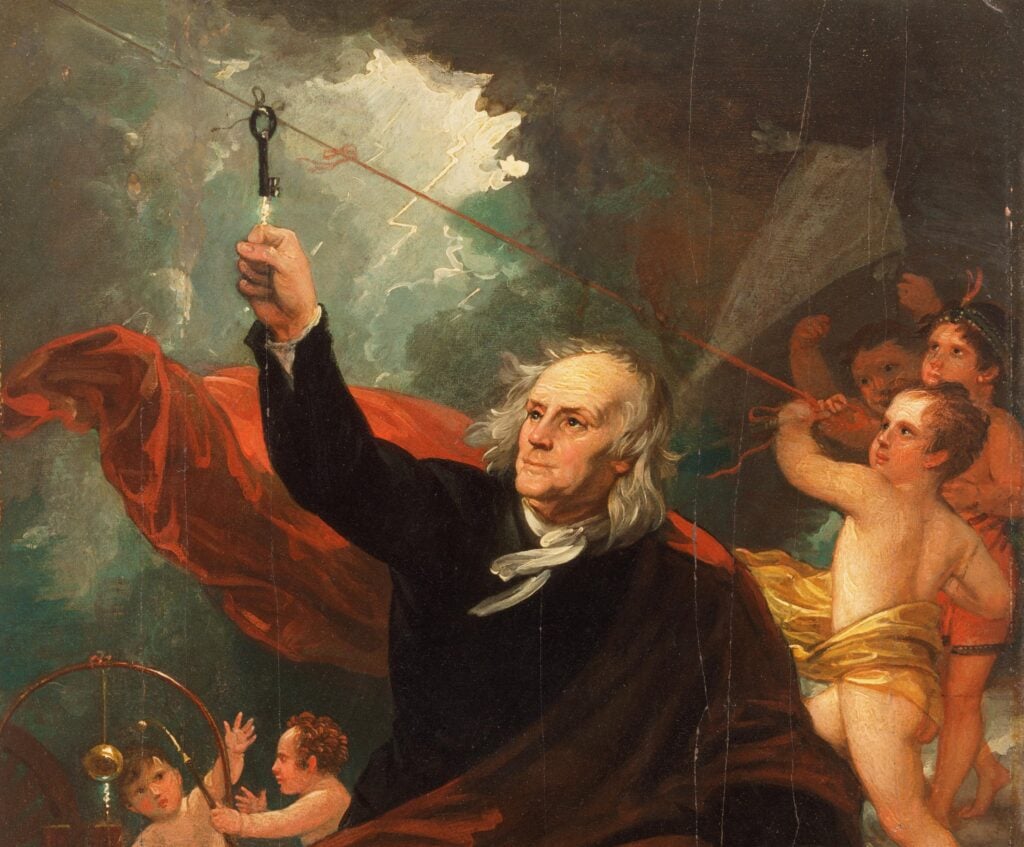

On July 1, 2016, the Maryland State House, the oldest still in legislative use, was struck by lightning. Smoke billowed from the wood dome, but firefighters found no fire. The lightning rod atop the dome, constructed to Benjamin Franklin’s specifications 208 years prior, safely redirected the current, preserving the historic building.
Although Franklin’s inventions1 are valuable, his most significant impact was as a statesman.
The only American to sign the Declaration of Independence,2 the Treaty of Alliance with France, the Treaty of Paris, and the Constitution, Benjamin Franklin was arguably second only—or perhaps equal to—George Washington in influence and equally necessary to victory. He led the development of U.S. diplomatic and foreign intelligence services, helping to turn the revolution into a lasting nation.
Born to a soap maker, Franklin made his fortune by spreading Enlightenment ideas to the masses.3 After retiring at age 42, Franklin turned his gigantic intellect to science. His experiments with electricity4 won him the 18th-century equivalent of the Nobel Prize and earned him acclaim from prominent Enlightenment thinkers.5
Initially a loyalist, Franklin lived in Britain for 18 years while serving as a colonial agent. Realizing that reconciliation was impossible due to the intransigence of the Crown, he landed in Philadelphia to learn that the British had fired on Massachusetts militiamen at Lexington and Concord, killing 90 colonists and 300 British troops. The next day, he was selected as a delegate to the Second Continental Congress, where he served despite a gout flare-up.6
America could not win independence without supplies. After arriving to take command, to Washington’s “great astonishment,” he was expected to defeat the most powerful military in the world with a mere 36 barrels of gunpowder. He rightly foresaw that a volunteer army would run out of recruits, but the ones he had would possess only 9 rounds each – as opposed to the 60 rounds the British carried.7 Had the British been aware of the patriots’ dire straits, the revolution would have ended before it began. Franklin learned the reality while visiting in October 1775.8
Gunpowder could not be manufactured in America quickly enough; they would have to go abroad. Unable to overpower the British, Washington used superior intelligence to outmaneuver them while he waited for reinforcements.9
As the leader of the “Committee of Secret Correspondence,” finding foreign allies fell to Benjamin Franklin. As a darling of the European elite, he was the obvious choice. Lesser men would decline a transatlantic journey at 71 years old, and recently near death.10 But Franklin, with his voracious curiosity, used the six-week journey to France to record the water temperature with a homemade thermometer11 instead of fretting about the Royal Navy scouting the sea for patriot ships.
France was the most likely sponsor12, as King Louis XVI was still smarting from the colonial losses in the French and Indian War. Upon landing, Franklin was met with an ecstatic welcome and a grand ball. Well known as a scientist, he appeared on medallions, rings, watches, and snuffboxes (complete with his signature fur cap in lieu of a powdered wig).13
The French had already been supporting the Americans covertly,14 as the foreign minister, Comte de Vergennes, believed another war with Britain was on the horizon for France. But the French Navy had been destroyed in the Seven Years’ War, and they needed time to rebuild. Slow bleeding Britain by supporting the colonists would provide just that opportunity. However, overt support would cause Britain to declare war before they were prepared. Furthermore, King Louis XVI required buy-in from his uncle, King Charles III of Spain.15
The colonists’ fortunes did not seem promising as Washington had just been defeated at Long Island. Complicating matters further, despite the warm welcome, representing a rebellion as a diplomat in a monarchy was a tightrope to walk, but Franklin appeared to do it effortlessly.
Affecting a joy de vivre, Franklin played the part of Rousseau’s “noble savage.” Recognizing the influence French women had on political opinions, Franklin wined and dined them. He frequented French salons with a carefree air, entertaining guests with music played on his armonica.16 He welcomed all guests to his residence in Passy, even as it was besieged by fellow inventors and revolution-minded enthusiasts. His charm offensive was so effective, his fellow Americans grew frustrated.17
What they did not know was that Passy was not only the first American diplomatic outpost, but the first hub for foreign espionage. Franklin worked through the night, writing propaganda, directing covert operations which included helping Americans captured by the British at sea to escape prison, conducting psychological warfare against George III, and commissioning privateers to seize British supply ships headed toward the colonies.
Franklin’s sharp wit convinced King Louis XVI to provide a much needed loan. Through report after report of Washington’s difficulties18, Franklin bluffed.19 In July 1777, Vergennes implored King Louis XVI, who agreed, to support America directly. It seemed as though Franklin’s efforts would pay off. What Vergennes and Franklin did not anticipate was King Charles III’s refusal to provide support, which aborted the French response.
Franklin was surrounded by British spies, including his personal secretary.20 For a full year,21 all correspondence between Congress and Franklin was intercepted. Arthur Lee, a fellow American delegate in Europe, also worked to undermine Franklin.22 After American losses at Fort Ticonderoga and Philadelphia, Vergennes closed French ports to American privateers. American victory seemed impossible.23
But all was not lost.
In December 1777, news reached Paris that the Americans had won the Battle of Saratoga. The French people cheered “as if it had been a victory of their own troops over their own enemies,” Franklin wrote. At last, France offered a treaty, drafted by Franklin, which included his modern principles of free trade. The terms paved the way for other nations to recognize the United States and trade with it.24 The only drawback was that the treaty once again required King Charles III’s agreement.
Franklin was not content to put America’s fate in Spanish hands. The British sent a spy, Paul Wentworth, to explore a truce with Franklin. Aware that the meeting would be noted by French spies, Franklin argued with Wentworth for two hours.
Vergennes, hearing of the meeting, panicked,25 assuming that America was considering a peace with Britain before France had a chance to get involved. The next day, Franklin was informed that the French military alliance was secure, regardless of Spain.
The Revolution (though it may pain modern Americans) could not have been won without France,26 and France27could not have been won without Franklin.28
Franklin, who loved Paris as it loved him, stayed until 1785. Another long voyage for someone extremely ill seemed unwise, but, as he told a friend, “I wish to die in my own country.”29
Yet Franklin still had more life to wear out in service to his country. He would make his last public appearance at the Constitutional Convention at 81 years old, attending daily in a wheelchair, despite excruciating pain. Too ill to make comments to a loud room, Franklin would write notes read aloud by others, saving the convention from a premature ending by proposing a compromise for the legislature, and at times lightening the contention with jokes.30
After four exhausting months in stifling heat, he implored all delegates to vote for the document, even if they did not agree with every part. Ever the wise statesman, he knew that the experiment with self-governance would be short-lived31 without a constitution. His parting gift to his beloved homeland was establishing a government that, when struck by the proverbial lightning of crisis, ensures that while smoke may billow, the structure remains intact.
The steady guidance of the wise men who secured individual liberty has created the most prosperous nation known to man. As the beneficiaries of freedom, may we remember and honor their sacrifice to keep a republic for another 250 years.
Footnotes
1 In addition to the lightning rod, Franklin invented bifocals, swim fins, the Franklin stove, and the Armonica, a glass instrument. He did not patent any of them, believing it was an “opportunity to serve others.”
2He served on the committee responsible for drafting the Declaration of Independence. Franklin edited Thomas Jefferson’s draft, changing Jefferson’s phrase “we hold these truths to be sacred and undeniable.” Franklin changed it to “self-evident.”
3 Poor Richard’s Almanac was one of the most popular colonial publications; its success made Franklin one of the wealthiest Americans.
4 His work was published in a book in 1751, which was translated into five languages and had eleven European editions and earned him a fellowship of the Royal Society.
5 Franklin was dubbed the “Prometheus of Modern Times” by Immanuel Kant. David Hume called him the “first philosopher” of America and America’s Isaac Newton. Voltaire would meet Franklin in 1778 and declare, “Behold, the man who tamed lightning!”
6 Gout is an incredibly painful form of arthritis in the feet. Franklin dealt with flare ups throughout his life.
7 Washington begged the colonies for “the smallest quantities” of gunpowder.
8 Additionally, Franklin pledged his entire postmaster salary to the effort.
9 “Washington did not really outfight the British, he simply outspied us!” Major George Beckwith, British Intelligence Officer 1782-1783.
10 In early 1776, Franklin joined a Congressional delegation to Canada tasked with convincing Canadians to join the rebel cause and secure the allegiance of the Native American tribes near the border. The mission was a complete failure, and Franklin nearly died on the journey.
11 Franklin was first to chart the Gulf Stream after wondering why some ships made the voyage between the colonies and Europe faster. His cousin, Timothy Folger, was a whaler and had made use of the current. Fisherman had informed British mail ships of the current, but they ignored it. Franklin did not, and charted the current.
12 French agents had met with Franklin in America to assess the strength of the colonists.
13 In 1791, a statue of Franklin was erected along Rue Benjamin Franklin, on Le Square de Yorktown. The plaque beneath the statue says “the genius who freed America and spilled torrents of light into Europe; the sage two worlds claim as their own.”
14 The French provided gunpowder, uniforms, and other supplies through a front company called Roderigue Hortalez and Co.
15 This was due to the Pacte de Famille, a defensive alliance between France and Spain. Spain, which had lost its 250-year hold on Florida in the Seven Years’ War. Still, Spain had more land in the western hemisphere than any other European nation, and did not want to risk losing it to independent Americans.
16 Franklin invented the arnoica in 1762. Queen Marie Antoinette learned to play it, and both Mozart and Beethoven composed for it.
17 Most notoriously, John Adams. A Young John Quincy Adams was so fooled he described Franklin as “more a Frenchman than an American.”
18 Back home, Thomas Paine was writing about the “times that try men’s souls.” Washington’s troops were ravaged by smallpox and Congress forcibly fled Philadelphia.
19 Franklin deflected questions about the collapse of the cause by referencing the British Ambassador, Lord Stormont: “Oh no, it is not the truth. It is only a Stormont.” Stormont became a slang word for “lie” in Paris.
20 King George III learned of Spain’s intentions from his spies.
21 May 177 to May 1778.
22 Lee’s efforts were somewhat successful. He spread rumors that Franklin had been skimming funds meant for the Continental Army. Franklin, who had personally contributed greatly, had done no such thing. In 1781, Congress made a motion for Franklin’s recall, and he tendered his resignation immediately, though it was not accepted.
23 “Everything in American affairs happens contrary to probability,” Thomas Hutchinson, Massachusetts Governor, 1779.
24 It would eventually lead to the 1780 League of Armed Neutrality, laying the cornerstone of American statecraft.
25 Vergnees wrote to the Ambassador in Madrid: “The power which first recognizes the independence in the Americas will be the one to gather all the fruits of this war.”
26 It is estimated that 90% of the gunpowder fired by American troops came from France.
27 In total, it is estimated that Franklin secured $40 million from the French, equivalent to $1.54 billion today.
28 Every other American envoy had failed.[28]
29 Once again struggling with his health, Queen Marie Antoinette lent Franklin her personal litter so he did not have to endure a rough carriage ride to the port.
30] At the end of the convention, Franklin pointed out a painted sun on Washington’s convention chair to James Madison and said, “I have happiness to know that it is a rising and not a setting sun.”
[31] The country was in the middle of an economic collapse as bad as the Great Depression; GDP per capita had shrunk 30%. European powers circled, fully expected to retake the colonies when convenient.

- We Got 9/11 Wrong – And We’re Still Getting It Wrong - September 11, 2026
- What It’s Really Like to Live Under Communism - August 27, 2026
- A Republic, if we can keep it - July 2, 2026