The Revolution will not be tweeted
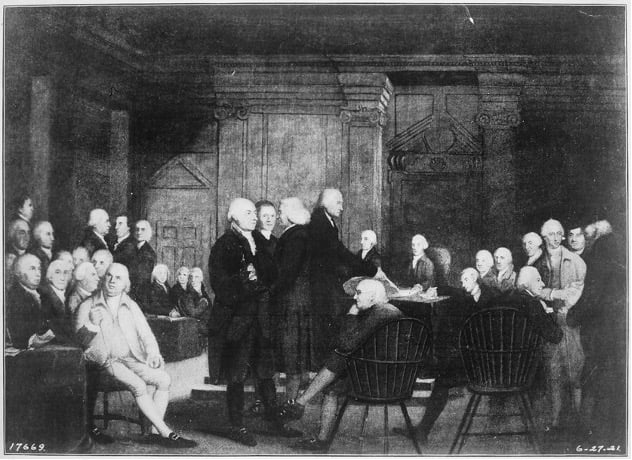

“The Revolution was in the minds of the people, and this was effected, from 1760 to 1775, in the course of fifteen years before a drop of blood was drawn at Lexington.”
–John Adams to Thomas Jefferson (1815)
It is very doubtful that there should have been a successful American Revolution if the colonists had the opportunity to avail themselves of Twitter or TikTok. If Samuel Adams and John Hancock had a video podcast, I suspect we would all still be speaking the King’s English.
This view runs counter to the populist instincts dominating political discourse today –and runs afoul of the utopianism of the technologists who promise us that ubiquitous access to information is the key to liberation.1 Surely, one might argue, if Thomas Paine’s Common Sense could electrify the nation as a pamphlet, how much more powerfully could he have impacted the Patriot cause with a million subscribers on Substack?
We celebrate the 250th anniversary of the signing of the Declaration of Independence, honored as the beginning of the Revolution. Yet that Declaration would have been impossible had it not been for the formation of Committees of Correspondence. They began in Boston and, at the urging of Samuel Adams, spread from 1764 onwards to every county and town, first in Massachusetts and then, by 1773, to the other colonies. These committees (and the committees of safety which followed them) were duly appointed yet secret, locally organized, but extensively networked across the colonies. It was from these localized networks that the Revolution sprang, seeing to the security, rights, and common good of their small communities, while ultimately forming the backbone from which the Continental Congress would be derived.
As a result, we celebrate on July 4th not the issuing of a demand but the declaration of a preexisting fact: “these United Colonies are, and of Right ought to be Free and Independent States.”
We were promised that the new information technologies would do something very much like the Committees of Correspondence –building networks of information sharing that could break down the control of institutions which had become increasingly imperious.
Yet they did not.
Before, as Glenn Reynolds wrote, “journalists and pundits could bloviate at leisure, offering illogical analysis or citing ‘facts’ that were in fact false.” We have now democratized disinformation, so the opportunity is enjoyed by all.
Instead of working with our friends and neighbors, those we know and trust, to achieve our desired politics in our local communities, we scream our demands into the void.
And the void screams back.
We find ourselves unable to tell whether our views are shared with the majority of our fellow Americans, or just the majority of the bots on some server in Islamabad or Kuala Lumpur. As a result, we are not building up local networks of like-minded patriots working for the common good, but increasingly isolated and fractious individuals who together make up a querulous mob of the kind our founders knew was easily reduced to despotism. We have traded local self-governance for the illusion of global self-expression, and it is a poor trade.
As we approach the 250th anniversary of this great nation, we should recall that for a Republic to endure, it must be regularly drawn back to its beginnings, reforged in the same modes by which it was founded.
No amount of likes or retweets will preserve your liberty or your safety. The only way to establish self-governance is to self-govern. If we begin today, we may find, as Adams did, that after a decade of this basic work the Revolution lives again in the minds of the people.
Footnotes
1 It is not information, but rather truth, that sets us free, and an increase in the former by no means equates to an increase in the latter.

- The Muslim Brotherhood Network and 9/11 - September 10, 2026
- Kyle Shideler, CSP Director and Senior Analyst for Homeland Security and Counterterrorism, quoted in Lee Smith article - September 4, 2026
- The Muslim Brotherhood’s long game in America-with Kyle Shideler - September 2, 2026