How the US ends up funding the Iranian Regime

Originally published by AND Magazine
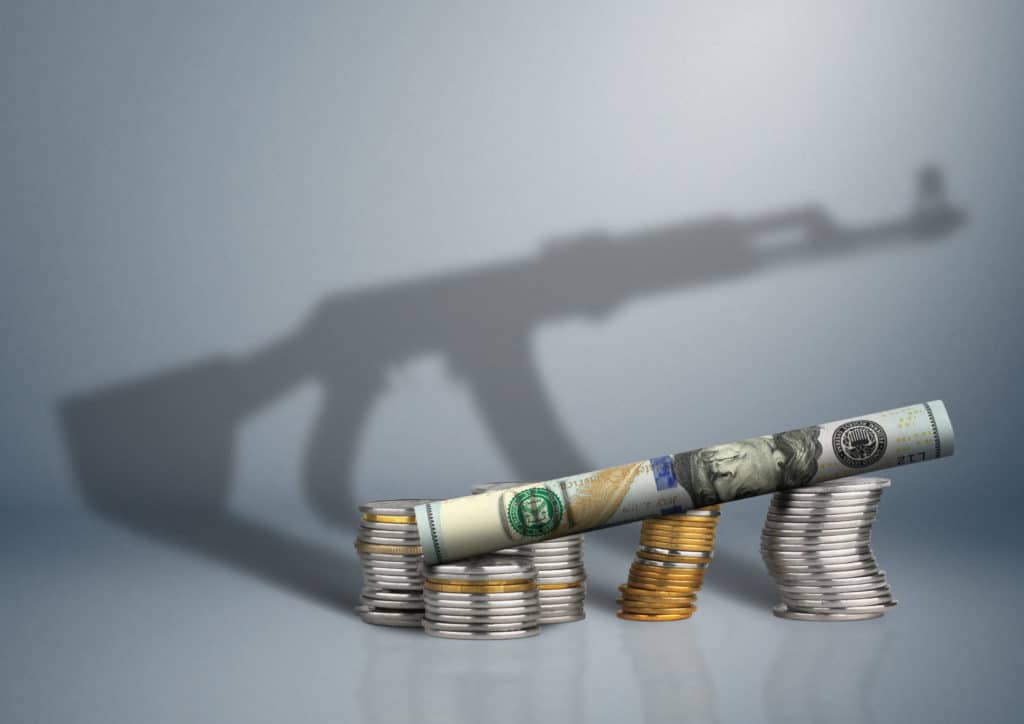
military budget concept, money with gun shadow
We are at war with Iran. Meanwhile, we are supplying Iran with hard cash to keep it afloat. This is how it works.
Ever since 2003, the U.S. Federal Reserve has been shipping pallets of cash to Iraq. Iraqi oil revenues are typically deposited into the Federal Reserve Bank of New York, and in exchange, because Iraq’s economy is heavily cash-based, we send physical U.S. currency to the Central Bank of Iraq.
We send a lot of cash, sometimes as much as $13 billion a year.
Once in Iraq, a substantial portion of this money is diverted or smuggled into Iran, particularly through Iran-backed militias and informal networks. These pro-Iranian groups access the cash via auctions, banks, fake invoices, and prepaid debit card schemes. Once physical $100 bills reach Iraq (via Fed shipments), militias move bulk cash across the porous border to Iran (e.g., via Diyala, Basra, or pilgrimage routes like Najaf-Karbala). The cash is carried in suitcases by couriers, hidden inside vehicles or goods, or stashed inside diplomatic pouches. Often, the militias involved have people on their payroll at the border crossings in question.
The New Arab
“This monstrosity was set up as a temporary solution to the total collapse of the Iraqi government and institutions with the invasion in 2003. That temporary, short-term fix evolved into the institutionalized corruption that plagues Iraq to this day. No one has the courage to address it. Trump is trying to get it fixed. He is the first president to take the issue on. With Iran crippled, perhaps the corruption within the central bank of Iraq can be fixed.”
A Retired Senior CIA Operations Officer – 2026
Why do the Iranians want U.S. dollars? Because the dollar remains the world’s dominant currency. U.S. sanctions have cut Iran off from access to the normal international banking system (SWIFT) and other dollar-clearing systems, but U.S. dollars are still required if you want to buy equipment, food, medicine, electronics, and other critical materials and items. Once the Iranians have U.S. dollars, they are then able, via shadow networks, front companies, hawala money dealers, and smuggling networks, to acquire imports that keep the economy (and military) running.
These illegally acquired dollars fund the IRGC, missile programs, and proxies (Hezbollah, Houthis, etc.). They also provide a hedge against inflation. The Iranian rial is highly unstable, but the regime is holding much of its wealth in physical U.S. dollars and so is insulated from this pressure.
Understand the scope of what is happening here. This is not a minor issue. In a very real sense, our shipments of cash are keeping Tehran afloat, and we have documented the issue repeatedly.
-In 2026, the US Treasury sanctioned the MVM partnership (a multinational network involving Iran, the UAE, Türkiye, and China). It procured sodium chlorate, sodium perchlorate, and sebacic acid from China for Iran’s Parchin Chemical Industries (part of the Defense Industries Organization). These are critical ingredients for solid rocket motor propellant in ballistic missiles. The network relied on diverted Iraqi dollars and shadow banking.
-Multiple 2024–2026 Treasury sanctions targeted networks (including the MADO Proliferation Finance network and Hong Kong/China-based fronts) that procured UAV engines, turbine engines, microelectronics, matrix switches, aviation parts, and related items worth millions of dollars for Shahed-131/136 drones (used by the IRGC and proxies). The payments were routed through illicit dollar channels, including those linked to Iraqi auctions and prepaid card arbitrage schemes.
-In 2024, an Organized Crime and Corruption Reporting Project (OCCRP) investigation traced tens of millions (e.g., at least $28 million) from Iraq’s dollar auctions (fed by NY Fed shipments) through banks like Al-Huda (sanctioned owner Hamad al-Moussawi, tied to IRGC-QF) to companies handling funds for IRGC financiers and Houthi supporters. These funds supported weapons procurement networks for missiles, drones, and regional proxies. US officials described the auction system as a “monster” funneling billions to fraudsters and militants.
-FinCEN and Treasury advisories in 2025 noted that revenue from Iraqi-sourced illicit dollars was laundered via exchange houses and front companies specifically to procure dual-use goods, chemicals, and components for ballistic missiles and UAV programs. This included electronics for missile guidance, drone assembly parts, and other proliferation-sensitive items.
Here’s the bottom line. We are in a shooting war with Iran, and we are supplying the dollars Iran is using to buy the weapons it is using to try to kill our soldiers, sailors, airmen, and Marines. Figure that out.
